


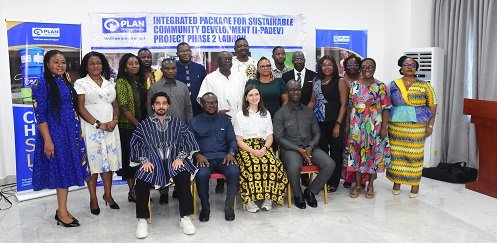
ABOUT 14,766 vulnerable women and girls in Guan and Wa East districts in the Oti and Upper West regions will benefit from a €1.36 million WASH project launched yesterday in Accra by Plan International Ghana.
The project forms part of Phase Two of the Integrated Package for Sustainable Community Development (IPADEV) and will run for 32 months.
It will cover 16 communities and 18 schools in the two districts, with the aim of expanding access to safe drinking water, improved sanitation and sustainable hygiene practices.
Acting Country Director of Plan International Ghana, Mr Frederick Tei-Nobi, said the intervention was designed to go beyond infrastructure provision to address dignity, equality and opportunity for women and girls.
“Access to safe water is not a privilege; it is a basic right. When a girl no longer misses school because she is searching for water or lacks a decent toilet facility, her future changes,” he stated.
Under the project, he said mechanised solar-powered and hand boreholes will be drilled to provide reliable water supply to beneficiary communities.
Mr Tei-Nobi explained that the shift to solar energy was informed by lessons from Phase One of the programme.
“In the first phase, boreholes were powered by electricity, and communities had to struggle with utility bills. This time, we are using solar systems to reduce costs and respond to climate concerns,” he noted.
The IPADEV Project Manager, Mr William Domapielle, said the project would also intensify hygiene promotion campaigns and scale up menstrual hygiene education in schools and communities to improve health outcomes and reduce absenteeism among girls.
He said 18 schools would benefit from improved WASH facilities aimed at creating safer and more dignified learning environments.
Mr Domapielle added that the initiative would establish Village Savings and Loans Associations (VSLAs) to strengthen household incomes and empower women economically, while promoting gender-responsive parenting and strengthening healthcare services to support early childhood care and development.
Describing the intervention as transformative, he said it would significantly improve conditions in deprived districts where access to WASH services remains limited.
“This project is about dignity, health and opportunity. When communities have safe water and decent sanitation, everything improves — education, health and livelihoods,” he stressed.
He further disclosed that spare parts banks would be set up to ensure faulty boreholes are repaired promptly, while water safety plans would be developed to safeguard water quality.
“We are building systems that will last. Communities should not wait months for a broken pump to be fixed,” he emphasised.
The Guan District Chief Executive, Mr Godfried Koku Kofie, pledged the Assembly’s commitment to ensuring the sustainability of the facilities.
He said the Assembly would collaborate with traditional leaders, assembly members and community water management committees to ensure that boreholes and sanitation facilities are properly maintained and protected against vandalism.
“We will not only welcome this intervention, we will safeguard it. Our people must see lasting value from these facilities,” Mr Kofie affirmed, adding that the Assembly would provide the necessary oversight and resources to keep the systems functional.
BY BENEDICTA GYIMAAH FOLLEY
Join our WhatsApp Channel now! GHANAIANTIMES OFFICIAL WHATSAPP CHANNEL

