


Three million people in Ghana remain vulnerable to food insecurity despite generally stable national consumption levels, the Government Statistician, Dr Alhassan Iddrisu, has warned.
He explained that although Ghana had not reached a nationwide food crisis, underlying pressures including inflation, climate-related shocks, and global supply disruptions continue to strain vulnerable households unevenly.
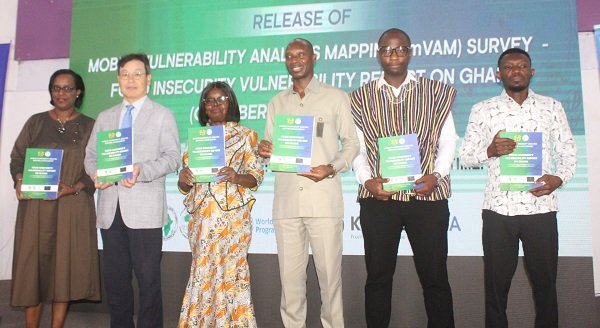
Speaking at the unveiling of the Mobile Vulnerability Analysis and Mapping (M-VAM) report yesterday in Accra, Dr Iddrisu said effective intervention depends on accurate and timely data, stressing that “we cannot respond effectively to what we do not measure clearly.”
The report, produced by the Ghana Statistical Service in collaboration with the World Food Programme and partners, assesses food insecurity trends using near real-time data collected via mobile phone surveys.
Dr Iddrisu said Ghana was navigating a challenging food security environment marked by rising food prices, inflation, climate shocks, and global disruptions, all of which are affecting household consumption patterns.
While about 91 per cent of households representing close to 30 million people have acceptable food consumption, he noted that the national average masks significant disparities.
“Beneath this average, about three million people remain vulnerable, facing poor or borderline food consumption,” he said.
The survey, conducted between October and December 2025, covered 9,000 households across all 16 regions.
It highlights that one in three households is adopting medium to high coping strategies, while nearly one in four is already in crisis or emergency coping.
These strategies include reducing meal quality, borrowing money, selling productive assets, and cutting spending on health and education.
“This is not sustainable. It means many households are managing today by sacrificing tomorrow,” Dr Iddrisu warned.
The findings also show that food insecurity is concentrated in specific regions and demographics. Nearly 40 per cent of households in northern areas—including the North East, Northern, Upper East, and Upper West regions experience poor or borderline food consumption.
Households without formal education are up to 10 times more vulnerable than those with tertiary education, while those dependent on small-scale agriculture face risks six times higher than those engaged in trading or other income sources.
Dr Iddrisu said the data underscores the need for more precise and targeted interventions.
He called for improved targeting of high-risk groups, early action based on warning signs, and expansion of social protection programmes.
Currently, only about 1.5 per cent of households report receiving assistance, a figure he described as insufficient.
He also emphasised the importance of investing in climate-smart agriculture, diversified livelihoods, and improved market access, noting that affordability—not distance remains the primary barrier for many households.
The report aligns with Ghana’s development priorities and the goals of United Nations Sustainable Development Goal 2 on zero hunger.
Dr Iddrisu urged policymakers to act decisively, warning that delays could deepen vulnerabilities.
“Ghana is not facing a nationwide food crisis, but we are confronting deep, concentrated and rising vulnerabilities that demand attention,” he said.
BY RAYMOND APPIAH-AMPONSAH
Follow our WhatsApp Channel now! https://whatsapp.com/channel/0029VbAjG7g3gvWajUAEX12Q

