


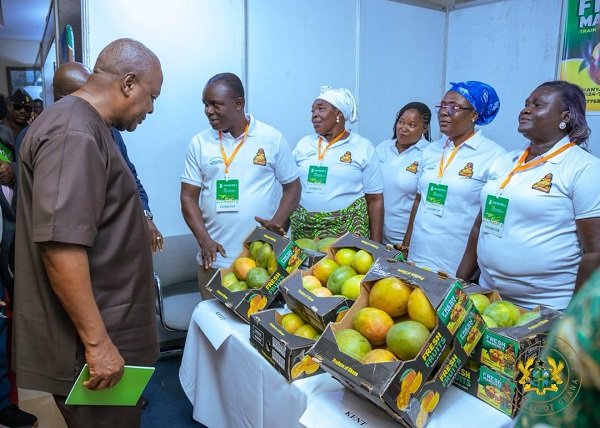
President John Dramani Mahama has announced plans to process at least 60 per cent of Ghana’s major tree crops locally each year to boost industrialisation, create jobs, and reduce dependence on raw exports.
Addressing the maiden Ghana Tree Crops Investment Summit in Accra yesterday, the President said the move, under the revised $200 million Tree Crops Diversification project, is expected to mark a turning point in the country’s agricultural sector by shifting it from primary production to value addition.
“We will no longer export raw cashew, raw shea, or unprocessed rubber while importing finished products at higher prices,” he stated, outlining government plans to expand agro-industrial parks, incentivise private-sector processing, and strengthen regulatory oversight through the Tree Crops Development Authority to attain the goal.
Held on the theme: ‘Sustainable Growth through Tree Crop Investment: Resetting and Building Ghana’s Green Economy,’ the summit sought to position Ghana as a regional hub for tree-crop processing and export, while tapping into international markets to drive inclusive growth and industrial transformation.
The event brought together investors, development partners, government officials, traditional leaders, and academics to advance the agenda.
President Mahama said the new strategy aligns with Ghana’s green economy and climate-resilience goals, noting that tree crops help absorb and store carbon from the air, reduce soil degradation, and strengthen rural economies.
“Through improved seedlings, farmer hubs, access to finance, and matching grants for small and medium enterprises, we will build inclusive value chains. Agriculture must be modern, profitable, and attractive to young people,” he indicated.
The President urged investors, development partners, and local stakeholders to support Ghana’s transition from raw exports to value-added industrial processing, stressing that the sector remains critical for economic growth, job creation, and export diversification.
In a speech, read on his behalf, the Asantehene, Otumfuo Osei Tutu II, commended the government’s efforts to diversify Ghana’s agricultural sector and highlighted the revenue potential of crops such as cashew, coconut, and mango.
He urged traditional authorities to make land available for responsible agro-industrial development, emphasising inclusivity, fairness, and shared prosperity.
“Traditional authorities are custodians of over 80 per cent of Ghana’s land. This responsibility goes beyond customs and traditions; it is a duty to future generations,” he noted.
For his part, the Minister of Food and Agriculture, Eric Opoku, reaffirmed the government’s commitment to repositioning the sector as a key driver of economic growth.
He said efforts were underway to strengthen regulatory oversight, improve data systems, and create a favourable investment climate.
“We are moving from fragmented production to organised value chains, from raw export to industrial processing, and from untapped potential to measurable prosperity. Our objective is clear: to make Ghana a leading player in the global tree-crop market,” he explained.
BY ABIGAIL ANNOH & AGNES OWUSU
Follow Ghanaian Times WhatsApp Channel today. https://whatsapp.com/channel/0029VbAjG7g3gvWajUAEX12Q
Trusted News. Real Stories. Anytime, Anywhere.
Join our WhatsApp Channel now! https://whatsapp.com/channel/0029VbAjG7g3gvWajUAEX12Q

