


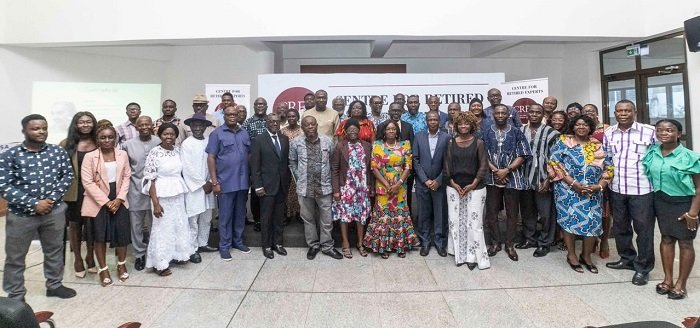
The Centre for Retired Experts (CREX) has called for deliberate national action to harness the knowledge and skills of retired professionals for Ghana’s development.
The call follows a study conducted by CREX in February 2026, which found that 96 per cent of 559 pensioners surveyed were willing to continue contributing to national development beyond the mandatory retirement age.
The study examined retirees’ willingness, motivation and capacity to undertake productive work after formal retirement.
Presenting the findings at a dissemination seminar in Accra, the Lead Researcher at CREX, Dr Adam Salifu, said about 90 per cent of the respondents were willing to mentor young professionals, while 88 per cent were prepared to serve as advisers or board members.
He, however, noted that only about one in five retirees remained professionally active despite the willingness of many others to contribute.
Dr Salifu said nearly 98 per cent of the retirees surveyed would register on a structured platform for retiree engagement, but 93 per cent were unaware of any existing platform where they could offer their expertise.
The study found that 97 per cent of the respondents believed there was a gap between the potential of retired professionals and the systems available to engage them productively.
According to the findings, retirees were motivated mainly by the desire to remain mentally active and contribute to national development rather than financial rewards.
About 84 per cent of the respondents were willing to contribute between one and four hours a day, while more than 90 per cent indicated that they could work between one and four days a week.
The study further showed that more than half of the retirees supported an increase in the current retirement age of 65, while about 86 per cent rejected the view that retirement had made them less useful to society.
Based on the findings, the CREX Director in charge of Research and Training, Dr Benedicta Quao, called for a coordinated national system to connect retirees’ skills and experience with opportunities in public institutions, private organisations and civil society.
She proposed that such a system should include transparent matching of retirees with opportunities, clear governance arrangements, flexible working options and standard guidelines for post-retirement contracts and incentives.
Dr Quao called for digital and lifelong learning programmes for retirees, systems to preserve institutional knowledge before employees retire, and mentoring programmes to connect experienced professionals with younger people.
The Executive Director of CREX, Prof Albert Martins, described the experience of retired professionals as a national asset and said Ghana was sitting on one of its richest but underused human-resource resources.
He warned that the country risked losing decades of institutional knowledge, technical skills, professional networks and leadership experience whenever qualified retired professionals were left without opportunities to continue contributing.
The CREX Director in charge of the Health Sector, Dr Chris Boamah-Mensah, said retired experts could help strengthen institutions, mentor the next generation and support development in communities.
He urged the government to view retirement as a new stage of national service rather than the end of productive contribution.
The CREX Director in charge of the Business Sector, Dr Sampson Narteh-Yoe, also urged public institutions, private organisations, civil society groups and development partners to establish practical systems to identify, register and engage retired experts.
The seminar was chaired by the Director of the UPSA Research and Consultancy Centre, Professor Alexander Preko, who expressed hope that the findings would encourage policy discussions and partnerships towards developing a national framework for harnessing the expertise of retired professionals.
By: Jacob Aggrey