


A stitch in time saves nine. It is a proverb often used to encourage early action before a small problem becomes a bigger one. In Ghana’s fight against child malnutrition, health experts say the saying carries a message the country can no longer afford to ignore.
Across child welfare clinics, health centres and communities, signs of malnutrition continue to emerge among children whose growth could have been protected through timely intervention. The consequences are not only borne by families but also by the nation as a whole.
For many experts, Ghana’s malnutrition challenge is becoming a costly reminder that prevention is always cheaper—and more effective—than cure.
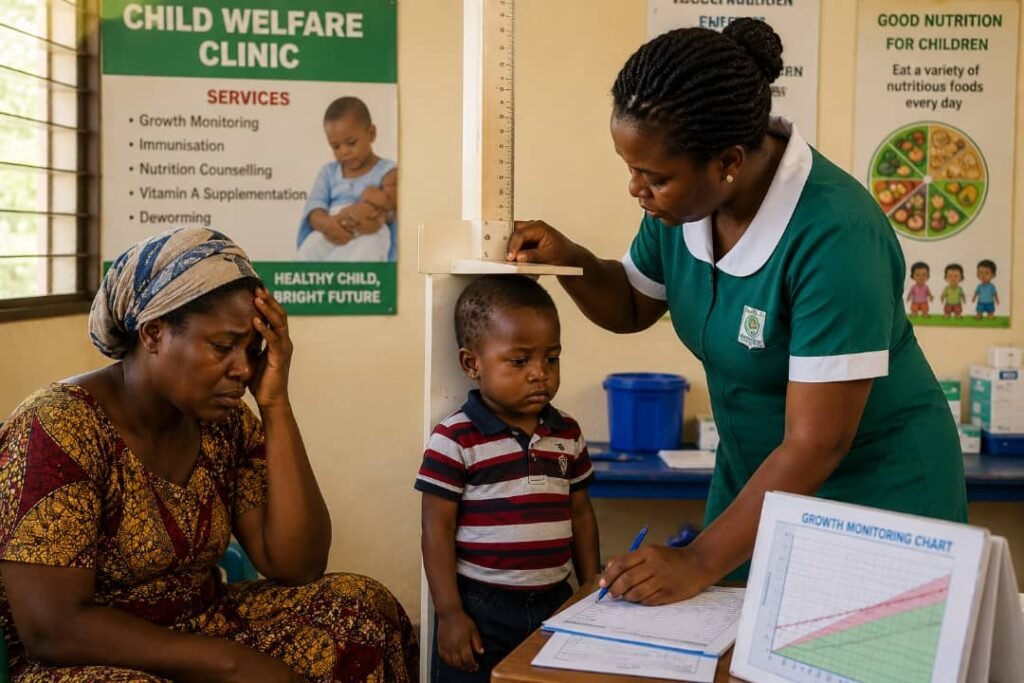
In Akraman, a community in the Ga West Municipality, fifteen-month-old Kwame sits quietly on his mother’s lap as health workers at the Akraman Health Centre record his weight and height.
His mother, Aunty Maggie, watches anxiously.
Months earlier, she had stopped attending some of his scheduled child welfare clinic visits after repeated immunisation sessions left him crying and feverish.
Believing she was protecting him, she stayed away.
When she eventually returned, health workers delivered news she never expected.
Kwame’s growth had slowed significantly.
He had become stunted.
“I thought I was protecting him. I didn’t know missing the visits could affect his growth” she said.
Her experience reflects a challenge that health professionals say is unfolding quietly in many communities across Ghana.
Unlike disease outbreaks that attract urgent national attention, malnutrition often advances silently, becoming visible only when the damage has already begun.
A Crisis Hidden in Plain Sight
Malnutrition remained one of the most persistent public health challenges facing Ghana.
According to the 2022 Ghana Demographic and Health Survey, 17 per cent of children under five are stunted, 12 per cent are underweight and six per cent are wasted.
Behind these statistics are children whose physical growth, cognitive development and future productivity may already be compromised.
The World Health Organization defines stunting as impaired growth and development caused by poor nutrition, repeated infections and inadequate care.
Experts warned that children who experience chronic malnutrition were more likely to struggle academically, suffer poor health outcomes and earn less income as adults.
Yet because the condition develops gradually, it rarely generates the urgency associated with infectious disease outbreaks.
That, experts say, is part of the problem.
At the Akraman Health Centre, Community Health Nurse Belinda Adjei says many children are brought to the clinic only after growth problems have already become serious.
“We are seeing them too late. Many caregivers do not realise that growth faltering happens gradually. By the time they return, the opportunity for early correction has already reduced” she said.
She explained that routine child welfare services were specifically designed to identify problems before they become severe adding that growth monitoring, nutrition counselling, immunisation, vitamin supplementation and caregiver education are all preventive interventions.
The First 1,000 Days: A Window That Never Reopens
Nutrition specialist and advocate Reina Darko experts describe the period from conception to a child’s second birthday as the most important stage in human development.
Known as the first 1,000 days, it is the period during which the brain develops most rapidly and the foundations for lifelong health are established adding that delays during this period could have irreversible consequences.
“The first 1,000 days of life are critical. If growth faltering is detected early, there is a greater chance of correcting it. The longer the delay, the harder it becomes” she said.
She explained that malnutrition is not simply about insufficient food but repeated infections, poor feeding practices, inadequate sanitation, unsafe water and delayed healthcare seeking can all contribute to poor growth outcomes.
The result is a vicious cycle in which illness and undernutrition reinforce each other.
According to her, undernutrition could reduce educational attainment, lower productivity and increase healthcare costs.
Mr Denzel Kwame Buabeng an economist said the World Bank has consistently identified nutrition investments as among the most cost-effective investments countries can make in human capital development.
For him, children who grow well learn better, earn more and contribute more to national development.
“Children who are left behind often carry those disadvantages throughout their lives. For Ghana, this means the effects of malnutrition are not only measured in hospital records but also in lost economic opportunities. Every child who is prevented from reaching his or her full potential because of malnutrition represents a loss to the nation,” Mr Buabeng said.
The Funding Challenge
While Ghana has made progress in expanding nutrition services, experts warn that many programmes continue to depend heavily on development partners and donor funding.
Support from organisations such as UNICEF, the World Food Programme and other international partners has played a significant role in sustaining nutrition interventions over the years.
However, global funding uncertainties have raised concerns about the long-term sustainability of programmes that rely heavily on external support.
Ruth Acquah-Sam a public health advocate argue that child nutrition should not depend primarily on donor priorities.
Instead, she said government financing must increasingly take centre stage.
“A nutrition programme funded today can prevent future healthcare costs, improve school performance and strengthen the country’s economic productivity. I therefore believe nutrition should be treated not as a welfare expenditure but as a strategic national investment. If we wait until children become severely malnourished, treatment becomes more expensive and outcomes become poorer,” she added.
Why Government Must Act
The Ministry of Health and the Ghana Health Service continue to implement interventions including growth monitoring, breastfeeding promotion, micronutrient supplementation and community nutrition education.
Yet experts say these efforts require stronger and more predictable domestic financing.
They are calling for increased government budgetary allocations to maternal and child nutrition programmes, expansion of community health services and strengthened public education campaigns.
According to them, relying heavily on donor support is not a sustainable strategy for addressing a challenge that affects Ghana’s future human capital.
Nutrition, they argue, must become a national development priority backed by long-term investment.
A Lesson Ghana Cannot Ignore
As the clinic day in Akraman comes to an end, mothers continue arriving with babies strapped securely to their backs.
Some are attending growth monitoring sessions. Others are bringing their children for immunisation. Each visit represents an opportunity to detect a problem before it becomes a crisis.
For Aunty Maggie, that lesson has become deeply personal. Holding Kwame close, she now understands the importance of early intervention.
But health experts say the lesson extends beyond one family. It is a lesson for communities, policymakers and government alike.
The evidence is clear. When countries invest early in nutrition, children thrive.
When they delay, the costs multiply.
Just as neglecting epidemic preparedness can leave nations vulnerable to devastating outbreaks, neglecting child nutrition can quietly undermine the future of an entire generation. The warning signs are already visible.
The question is whether Ghana will act before the costs become even greater.
Because when it comes to child malnutrition, a stitch in time does not only save nine—it can help secure the future of a nation.
By Benedicta Gyimaah Folley