


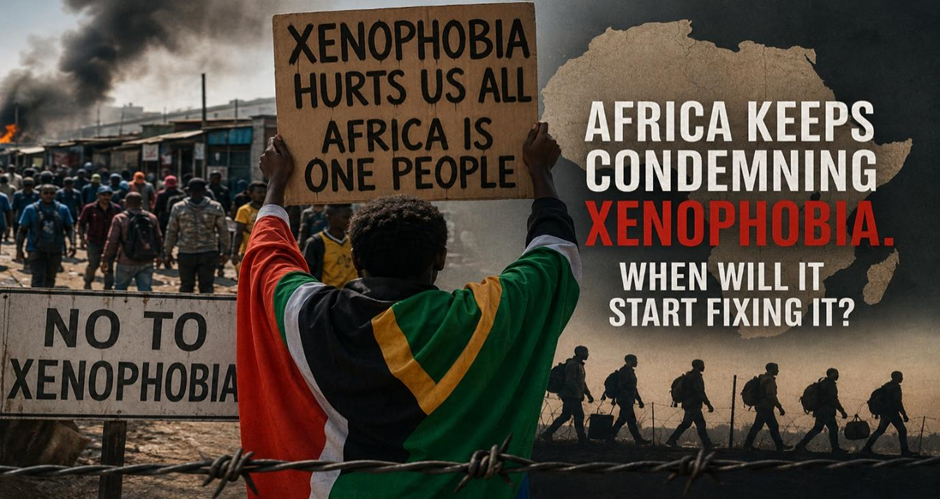
“You can speak all you want at the African Union… it is our children being trafficked, our money being scammed, our kasi spaza businesses being taken, and our citizens kidnapped.”
The post, shared on X by a South African user, reflects anger that resurfaces every year in parts of the country over undocumented migration, unemployment, and pressure on public services. In many communities, foreign-owned businesses have become flashpoints, with migrants often accused of contributing to crime and economic strain.
For many African migrants living in South Africa, however, the debate is not online or abstract. It is lived through fear, harassment, and periodic outbreaks of hostility that continue to shape daily life, particularly in economically strained townships where competition over jobs and informal trade is intense.
Kojo, a Ghanaian trader based in Johannesburg, said the anxiety is constant.
“You don’t really relax here,” he said. “Even when business is good, you are always thinking what could happen if something starts. You see how people are treated, and you just stay alert all the time.”
In the wake of recent attacks, Mr Samuel Okudzeto Ablakwa, the Minister for Foreign Affairs, has formally petitioned the African Union over xenophobic violence against Ghanaian citizens in South Africa.
The letter argues that the continued attacks violate the African Charter on Human and Peoples’ Rights, weaken Pan-Africanism, and go against the goals of the African Continental Free Trade Area (AfCFTA), which is meant to support free movement and economic integration across the continent.
Between 2020 and 2024, recorded incidents of xenophobic discrimination in South Africa remained high. According to data tracked by the Xenowatch monitoring project, xenophobic incidents stood at 58 in 2020, rising to 79 in 2021, peaking at 110 in 2022, before dropping to 62 in 2023 and increasing again to 83 in 2024.
Human rights organisations have also documented thousands of people affected in individual incidents, including entire communities displaced from their homes.
However, the numbers that rarely make it into this debate tell a different story. According to Statistics South Africa, the official unemployment rate stood at 31.4 per cent in the final quarter of 2025, while the rate for young people aged 15 to 24 was 57 per cent.
South Africa’s own 2022 census, meanwhile, puts migrants at just 3.9 per cent of the total population around 2.4 million people in a country of 62 million.
The narrative of a country overrun by foreigners does not survive contact with the data.
Across the continent, xenophobia is repeatedly condemned at the diplomatic level, but rarely addressed where it actually begins, at the community level. At the heart of these reactions is a widening gap between official political statements and the lived realities that shape public resentment on the ground.
The diplomatic move by Ghana has also exposed an uncomfortable irony. Even Ghana, which now asks the African Union to protect its citizens from xenophobia in South Africa, has faced its own domestic tensions with foreign traders, particularly Nigerians.
As one Nigerian user on X put it: “Ghana is no exception. Ghanaians are also on the streets fighting this global pandemic called Nigeria.” The comment highlights a continent-wide pattern. The same pressures that fuel anti-migrant sentiments in Johannesburg also surface in Accra, Lagos, and Nairobi, often with little institutional response until violence crosses a border.
What is consistent is not only the recurrence of these tensions, but also the absence of sustained institutional mechanisms capable of addressing them before they escalate.
However, lawyer and activist Oliver Barker-Vormawor saw it differently. Writing on X, he captured the intensity of public reaction on the other side of the continent: “South Africans confront one Ghanaian. We summoned their ambassador and escalated the issue to be put on AU’s agenda. This is Ghana we deserve.”
At the institutional level, Ghana’s petition has pushed xenophobia into formal continental discussion, but it also highlights the limits of current migration governance structures. Migration across Africa is shaped by deep structural pressures, unemployment, inequality, conflict and demographic growth, which continue to drive movement within and across borders.
Osei, another Ghanaian who has lived in South Africa for the past two years, described migration in an interview as a matter of survival. “It is only because of something we can get for our families back home,” he said. “The government must help us, otherwise all these attacks will not stop happening. I cannot go back home when I have a family to feed and things are hard.”
For countries like South Africa, Ghana and Kenya, receiving large numbers of migrants means mounting pressure on housing, services, and informal work. At the same time, the countries people are leaving struggle to create enough jobs to keep their own populations home.
Migration experts caution that economic pressure does not justify scapegoating migrants. They argue that when foreign nationals are blamed for failing governments and strained systems, it deepens social divisions while leaving the real problems untouched.
The question that follows these tensions is not new. Between 2020 and 2022, a UN Joint Programme quietly ran across some of South Africa’s most tension-prone communities in Gauteng, KwaZulu-Natal, and the Western Cape.
Instead of issuing statements, the UN Joint Programme went into neighbourhoods. It trained 1,940 community leaders and created women’s peace clubs. It brought migrants and South Africans into the same room and taught local officials to spot trouble before it started. The programme reached over 940,000 people across seven community peace initiatives. It ended in 2022 and has not been renewed.
What was lost was not just a project, but proof that something simpler than summits can actually work.
African governments need to fund community-level dialogue programmes permanently, not as short-term projects that end when donor money runs out. They need to fast-track documentation for migrants so people are not left in legal limbo. And the AU needs to move beyond resolutions and tie its free movement agenda to binding obligations on how member states treat foreign nationals on the ground.
By Eyram M.A. Yorgbe
Follow our WhatsApp Channel now! https://whatsapp.com/channel/0029VbAjG7g3gvWajUAEX12Q

