


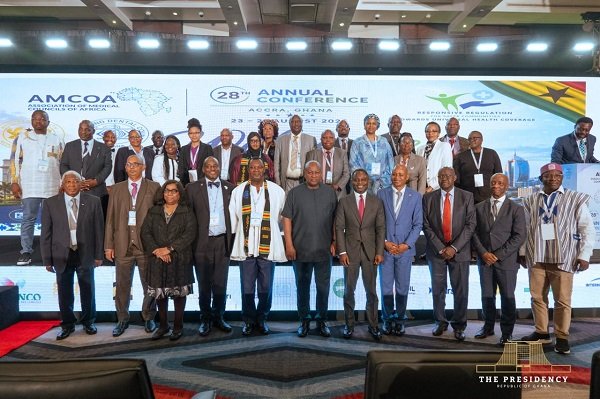
President John Dramani Mahama has called for stronger and more responsive regulation of Africa’s health sector to protect patients as Artificial Intelligence (AI), telemedicine and cross-border healthcare continue to expand.
He said health regulation must keep pace with emerging technologies and changing healthcare needs, warning that access to healthcare without adequate safety and quality standards could put lives at risk.
The President made the call in Accra yesterday when he opened the 28th Annual Scientific Conference of the Association of Medical Councils of Africa (AMCOA).
The conference, being attended by health professionals, experts, medical practitioners and researchers from across Africa, is on the theme: ‘Responsive Regulation for Safer Communities Towards Universal Health Coverage.’
President Mahama indicated that regulators must ensure that every health professional who was licensed to practise was properly trained, assessed and registered, and adhered to professional and ethical standards.
“Regulation is, therefore, not a bureaucratic obstacle. It is public protection, patient safety and the foundation of confidence in healthcare,” he mentioned.
He said the rapid growth of digital health was creating new risks that regulators could no longer afford to ignore.
President Mahama recalled an experience in Ghana in which a provider of a digital medical records system repeatedly demanded additional payments and later switched off the system.
The incident, he underlined, compelled the government to retrieve old medical records from archives and develop a replacement system.
He said the experience raised important questions about data ownership, dependence on technology providers and the continuity of healthcare services.
The President also questioned who should be held responsible when a health professional in one country treated a patient in another through telemedicine, or when an AI system contributed to a harmful medical decision.
He called for strong regulations to protect health data and prevent digital platforms from being used for fraud, unlawful advertising and unsafe medical practices.
President Mahama stressed that AI should support professional judgement rather than replace human responsibility.
He also cautioned against the use of AI systems trained on datasets that did not adequately represent African patients, saying such systems could produce inaccurate diagnoses and pose serious risks to patients.
Furthermore, President Mahama called for greater cooperation among African health regulators to tackle fake qualifications, forged licences and professional impersonation.
He said regulators should share verified information promptly to prevent practitioners sanctioned in one country from moving to another country to continue practising.
“No country should become a refuge for a practitioner sanctioned elsewhere,” he emphasised.
On universal health coverage, President Mahama stated that Ghana was strengthening the National Health Insurance Scheme (NHIS), which currently covers about 76 per cent of the population, with a target of reaching 90 per cent.
BY AGNES OPOKU SARPONG