


The government must introduce stringent measures to block Illicit Financial Flows (IFFs) and tax leakages in order to boost the country’s revenue generation, the Institute of Statistical, Social and Economic Research (ISSER) of the University of Ghana has stated.
According to ISSER, if government successfully curbs IFFs and tax leakages, the country will have enough financial resources to fund the national budget without resorting to borrowing.
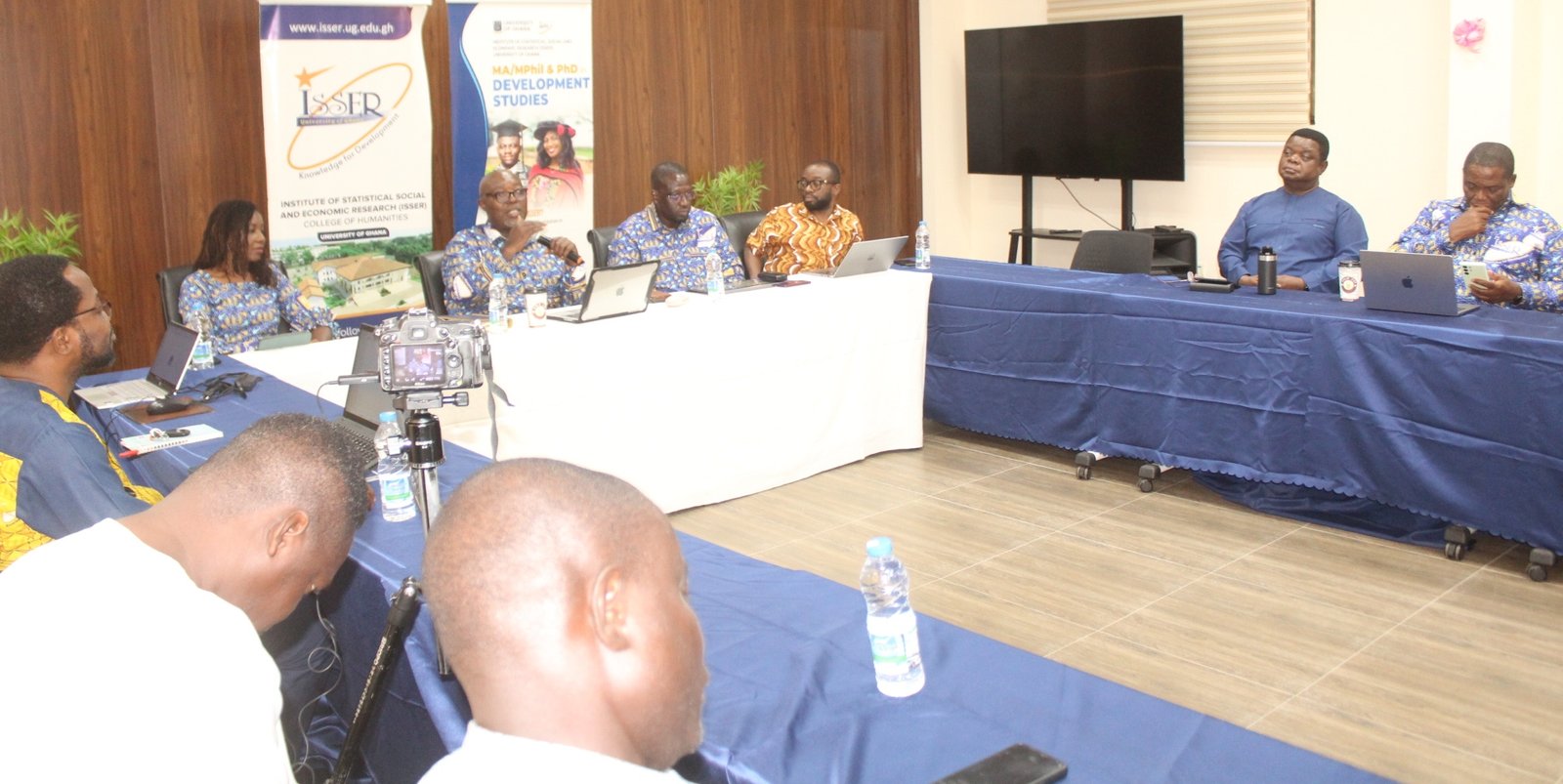
The Director of ISSER, Professor Robert Darko Osei, who made the call during the institute’s review of the 2026 budget and economic policy yesterday, commended government for reforms in the Value Added Tax (VAT) sector and the reduction of the VAT rate from 21 to 20 per cent.
Prof Osei, presenting ISSER’s opinion on the 2026 budget, also praised government’s agricultural policies, describing the steps outlined for the sector as “very important”.
He said the renewed focus on the oil palm sector was commendable, adding that the initiatives introduced were “excellent”. He urged government to prioritise the entire value chain of the palm industry to maximise value addition rather than concentrating solely on production.
On the energy sector, Prof Osei called for urgent restructuring to address transmission losses, which currently stand at about 27 per cent, noting that the losses continue to create huge debt burdens.
He further described as laudable the government’s decision to revise the investment arrangement for oil and gas revenues to secure better returns.
However, ISSER expressed concern over dwindling government allocation to capital expenditure (CAPEX). Although CAPEX is projected to increase to 2.9 per cent of Gross Domestic Product (GDP) in 2026 from 1.7 per cent in 2025, Prof Osei said the figure remains far below the African average of 10 per cent.
“In a country where infrastructure is poor, it is worrying that government CAPEX is not expanding,” he said.
Prof Osei noted that the “Big Push Agenda” was not adequately reflected in the 2026 budget, as government did not provide costing for the two major projects under the initiative — the Accra-Kumasi Express Highway and the proposed bridge over the Afram River in the Afram Plains of the Eastern Region. Without costing, he said, it would be difficult to assess value for money.
He also pointed out a “disconnection” between government’s trade policies in the 2026 budget and objectives under the African Continental Free Trade Area (AfCFTA).
On education, ISSER called for a national dialogue on the funding of higher education. Prof Osei warned that if the current funding model is not reviewed, the country could face serious challenges in delivering tertiary education within the next 20 years, as existing tuition fees do not reflect the true cost of training students.
An economist at ISSER, Professor Peter Quartey, said the Free Senior High School policy is beneficial and should not be scrapped, noting that “a literate population is better than an uneducated one”. He suggested, however, that the policy be reviewed to cover only tuition fees, similar to models in the UK and US, where the policy framework originated.
By KINGSLEY ASARE & EUGENE AMPIAW
🔗 Follow Ghanaian Times WhatsApp Channel today. https://whatsapp.com/channel/0029VbAjG7g3gvWajUAEX12Q
🌍 Trusted News. Real Stories. Anytime, Anywhere.
✅ Join our WhatsApp Channel now! https://whatsapp.com/channel/0029VbAjG7g3gvWajUAEX12Q

