


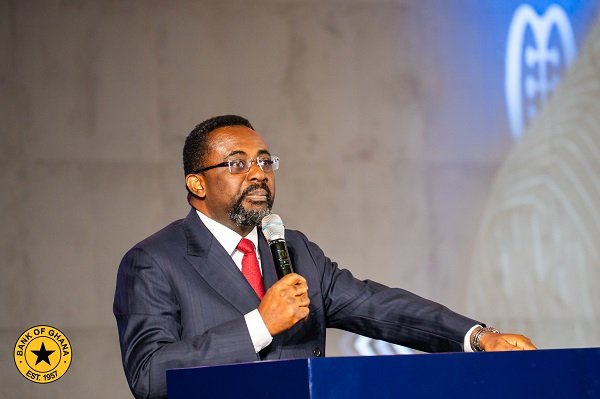
The Monetary Policy Committee (MPC) of the Bank of Ghana (BoG) has maintained the Monetary Policy Rate at 14 per cent, citing strong macroeconomic stability and broadly balanced risks to inflation and growth.
The BOG said although geopolitical tensions in the Middle East continued to pose risks to the global economy, Ghana’s macroeconomic fundamentals remained strong.
Announcing the decision at the end of the 130th MPC meeting in Accra on Wednesday, the Governor of the BoG and Chairman of the Committee, Dr Johnson Pandit Asiama, explained that the ongoing conflict in the Middle East had weakened the global growth outlook, heightened policy uncertainty and reignited inflationary concerns due to rising energy and food prices.
According to him, the disruption of maritime and air traffic, particularly around the Strait of Hormuz, had contributed to a sharp rise in international crude oil prices, with the International Monetary Fund (IMF) subsequently revising down its 2026 global growth forecast from 3.3 per cent to 3.1 per cent.
Dr Asiama stated that despite the difficult global environment, spillover effects on the domestic economy through trade channels had so far remained muted.
“The committee assessed risks in the outlook to inflation and growth as broadly balanced and therefore decided to maintain the monetary policy rate at 14.0 per cent,” he said.
He noted that the domestic economy continued to recover strongly, supported by private sector credit growth, industrial production, consumption and international trade activities.
The Composite Index of Economic Activity (CIEA) expanded by 12.6 per cent year-on-year in March 2026, compared to 2.3 per cent in the corresponding period last year.
However, he cautioned that commodity price volatility and supply chain disruptions could pose downside risks to growth in the coming months.
On inflation, Dr Asiama said headline inflation increased marginally to 3.4 per cent in April 2026 from 3.2 per cent in March, marking the first increase since December 2024.
The rise, he explained, was mainly driven by non-food inflation, which increased to 4.2 per cent from 3.9 per cent due largely to base effects.
He, however, noted that core inflation continued to decline, indicating easing underlying inflationary pressures, while inflation expectations remained broadly anchored within the medium-term target band.
The Governor said risks to the inflation outlook included the possibility of prolonged Middle East tensions keeping crude oil prices above $100 per barrel, with potential pass-through effects on domestic transport and utility costs.
He added that the quarterly adjustment mechanism for utility tariffs could also exert upward pressure on non-food inflation.
Nonetheless, he said exchange rate stability, rising reserve buffers and continued fiscal discipline were expected to moderate these risks.
As part of additional policy measures, the Committee also decided to amend the Dynamic Cash Reserve Ratio to a uniform ratio of 20 per cent, to be maintained in domestic currency effective June 4, 2026.
On the external sector, Dr Asiama said Ghana’s gross international reserves rose to $14.4 billion as of May 18, 2026, equivalent to 5.7 months of import cover, compared to $13.8 billion in December 2025.
He further disclosed that the cedi had depreciated by 8.4 per cent against the US dollar as of May 15, 2026, largely due to increased demand from the energy sector and dividend payments by some corporate entities
BY KINGSLEY ASARE
Follow our WhatsApp Channel now! https://whatsapp.com/channel/0029VbAjG7g3gvWajUAEX12Q

