


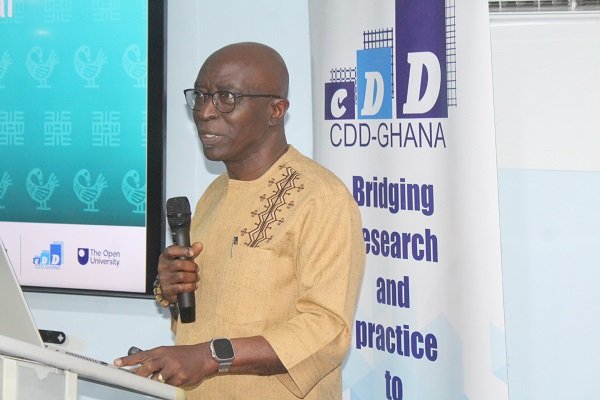
The government and policymakers have been urged to design and implement policies that promote equity in Ghana’s education sector, particularly at the basic level, to ensure fair access to quality learning for all children.

A Senior Fellow at the Centre for Democratic Development (CDD-Ghana), Kwame Akyeampong, warned that failure to prioritise equity in education would undermine national development and long-term growth.
Delivering a public lecture in Accra on the theme: ‘Reconceptualising the Learning Crisis’ for Social Justice: The Case of Ghana,’ Prof. Akyeampong underscored the need to focus resources on children who lack access to quality education.
He noted that fairness in education required ensuring that every child at the basic level receives the quality of instruction they deserve.
“Education needs to make sure that at the foundation level, every child who goes to school gets the best quality of education he or she deserves, which means that we may have to give those places where there are fewer resources more,” he emphasised.
Prof. Akyeampong cautioned that persistent learning gaps must be addressed urgently.
“It should not be the case that in a year or two, children who go to school in Ghana do not achieve basic numeracy and literacy within one year,” he added.
He further emphasised the importance of enrolling children in school at the right age, noting that delayed enrolment increases dropout rates.
“We also have to make sure that our children go to school at the right age, which is at the age of six, because if they attend school at a later age, they are more likely to drop out,” he explained.
He recommended that the Ministry of Education maintain health and enrolment records to support timely school attendance, adding that late enrolment remains more common in rural communities than in urban areas.
Prof. Akyeampong also called for stronger decentralisation of education by equipping local governments with adequate resources. He advocated the use of mother-tongue instruction at the basic level to improve learning outcomes and urged greater involvement of mothers in children’s education.
He further called on citizens to hold political leaders accountable for failures in education policy.
In his remarks, the Executive Director of CDD-Ghana, H. Kwesi Prempeh, attributed weaknesses in education policy to political interests, noting that some leaders prioritise private schooling for their children while public schools remain under-resourced.
The lecture brought together civil society organisations in education, teacher unions, officials of the West African Examinations Council (WAEC), and former Member of Parliament for Tamale Central, Inusah Abdulai Bistav Fuseini.
BY BENJAMIN ARCTON-TETTEY
Follow our WhatsApp Channel now! https://whatsapp.com/channel/0029VbAjG7g3gvWajUAEX12Q

