


Overview
THERE are growing concerns about low citizen participation, transparency and accountability in Ghana’s public space, particularly within infrastructure arena and across all sectors of the economy.
What is more worrying is the lack of consultation with community members to ensure project execution that satisfies the needs and aspirations of the people. The corollary is the absence of ownership and lukewarm community attitude. Some projects end up being abandoned, either due to poor execution or the disinterestedness of the next government to continue same.
“Ghanaians should be concerned with corruption issues in all sectors, particularly in the oil and gas sectors. The Office of the Special Prosecutor (OSP) in 2025 was very hot. We don’t have the power of arrest or prosecution. We will tell you the stories and get everybody on board,” he advocated.
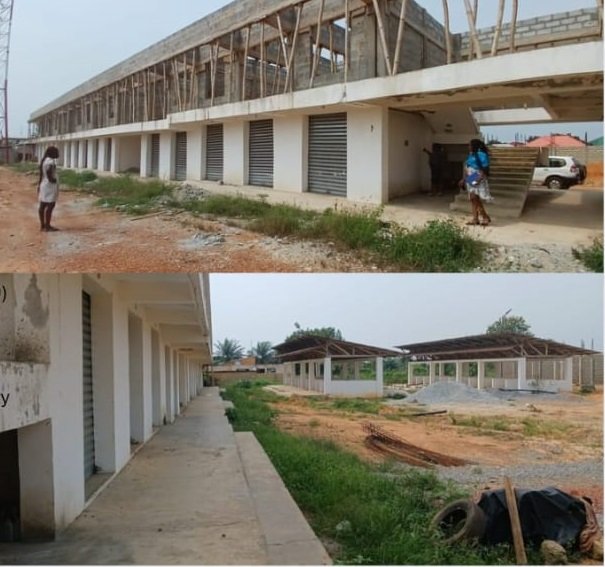
• The 40-seater lockable market at Nzema East
But, the wastage must stop; we cannot afford this cycle of impunity when we hear daily lamentation that, “We are poor, and there are no nails.” No! Historically, the cycle of insensitivity spans most Public Interest and Accountability Committee (PIAC) reports in the use of oil moneys that funded the Annual Budget Funding Amount (ABFA). Also, the top-down approach to development has not changed. Meanwhile, the citizenry behave as if “there is nothing at stake.”
Reflection on literature
Interestingly, as I wound up this piece, I encountered on Google Roger Agana’s review of Oteng Gyang’s book Ghana Dismantled, 1966 to 2066: 60 Years of Dismantling a Nation, which diagnosed Ghana’s predicament including policy discontinuity, elite capture and the erosion of state capacity.
Roger notes that Oteng’s book presents “a pattern of accumulated institutional weakening, in which each cycle of political transition tends to disrupt ongoing reforms, redirect resources toward patronage, and subordinate long-term national interests to short-term political calculations.”
GCCA/LANets collaboration
Yes, nothing has changed; these realities were revealed at various assemblies in Western Region at a stakeholders’ engagement organised by Ghana Anti-Corruption Coalition (GCCA) in collaboration with the Local Accountability Networks (LANets), at Effia in Takoradi.
The project, themed: ‘From disclosure to impact: Mobilising local civil society to verify published extractives data and advocate equitable and accountable spend of funds,’ is funded by the African Centre for Energy Policy (ACEP). It seeks to enhance transparency, accountability, and citizen participation in the management and utilisation of Ghana’s petroleum revenues, particularly those allocated through the ABFA.
Matters arising
During discussions, Samuel Harrison-Cudjoe, project officer, GCCA, argued that if no action is taken on corruption reports, the citizenry would be fatigued.
He added that, “The Big Push programmes are also coming and we need to be careful. We need the citizens as crusaders. We need to be serious, get citizens actively involved in advocacy on transparency and accountability issues. It’s sad. In some places, we didn’t see the projects.”
He mentioned that GCCA reports, which covered government efforts in addressing corruption and non-compliance issues in the extractive sector report from June 2022 to March 2024, revealed limited or non-involvement of districts.
Again, Harrison-Cudjoe narrates that beneficiaries including women, girls, children and vulnerable groups were not part of the project design and implementation of the ABFA-funded projects.
Besides, there was limited project information on contract details, including the contractor, expenditure and duration, funding sources, disparities in contract sum, poor quality of some projects, he added.
Wastage of projects
This one critical concern as Harrison-Cudjoe cited an example at Nzema East, where reports on a two-storey market revealed variation in design and cost, because the works department agreed at a meeting that the project should be a single floor because people hardly take stores on top floors.
Therefore, the project delayed for about four and a half years. A contract, which was awarded on December 23, 2019 and expected to be completed in May 23, 2020, was completed in 2024.
“Electrical works were near completion except the cabling that was yet to be done. But, traders fear they might not have the opportunity to rent the stores due to high cost and politicisation of project,” he lamented.
More challenges
An executive member of LANets, Stephen Kweku Buah, also presented reports on selected Coastal Development Authority (CODA) oil-funded projects that highlighted same critical findings. Project not traced: These include the construction of U-Drain at Kwesiminstim, Butumajebu community centre and the Hassacas Park drainage.
Project abandoned
The monitoring, Mr Buah emphasised, showed the construction of storm drain from Unicom to TTU in the Effia Constituency, funded by CODA at the cost of GH¢199,949.52 in 2019, had been abandoned. The contractor is reportedly based in Accra.
“Again, construction of a community centre at Sofokrom in the Essikado-Ketan constituency, funded by CODA at the cost of GH¢166,242.20 in 2020, had been abandoned. Meanwhile, the walls showed deep cracks,” he added.
Cost overrun
One example of this is the construction of the Apremdo Township road in Kwesiminstim constituency, funded by CODA, awarded to Addison Property and Investment, on May 5, 2020 to be completed in six months at cost of GH¢1,293,273.56 but the contractor was paid GH¢2,664,733.56. Now there are potholes, no zebra crossing, streetlights and poorly constructed side gutters, Mr Buah commented.
Rationale
The objective of the GCCA/LANets project, Harrison-Cudjoe explained, was to pave way for an effective implementation of the “Big Push” agenda which requires strong institutional coordination, transparency and disclosures and local ownership and supervision from start to finishing. The GCCA study established that the creation of parallel government institutions and the award of contract from the nation’s capital hampered quality infrastructure delivery.
Another viewpoint
To Nana Egya Kwamina XI, the Chief of Apremdo, “Projects are carried out from state coffers and not any political party. Politicians must begin to reason with their constituents to gain their trust on developmental issues.”
Conclusion
The present Ghana’s predicament must prick citizens’ consciousness on political patronage and wastage that dot the infrastructure space. To Roger, Oteng Gyang asks in his book as to “what Ghana risks becoming if the institutional patterns it documents remain uncorrected,” noting, it is not merely a historical account but a policy warning.
BY CLEMENT ADZEI BOYE
Trusted News. Real Stories. Anytime, Anywhere.
Join our WhatsApp Channel now! https://whatsapp.com/channel/0029VbAjG7g3gvWajUAEX12Q


Follow the latest videos and updates on the official YouTube channel of Ghanaian Times.