


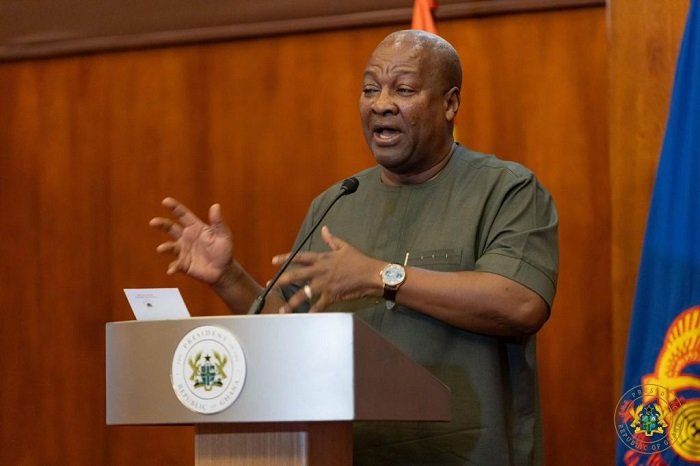
President John Dramani Mahama has announced that a new bill will soon be laid before Parliament to guarantee cocoa farmers at least 70 per cent of the world market price.
He explained that the proposed legislation, expected in the coming weeks, would also mandate that 50 per cent of Ghana’s cocoa output be processed locally to add value and create jobs.
President Mahama said the move was necessary to ensure that farmers benefited more fairly from the wealth they help to generate, stressing that they deserved a greater share of the proceeds.
He made the announcement yesterday at the opening of the 2026 Ghana–European Union (EU) Partnership Dialogue in Accra.
According to him, the bill forms part of the government’s broader strategy to transform the agricultural sector, promote industrialisation and improve returns to farmers.
The President further disclosed that the government had cleared the way for the Ghana Cocoa Board (COCOBOD) to raise local financing to purchase cocoa beans for the upcoming crop season. He added that the administration remained committed to processing at least half of the country’s cocoa locally to create jobs, particularly for the youth.
President Mahama also expressed appreciation to the European Union for its continued support to Ghana’s cocoa sector, especially efforts to combat cocoa swollen shoot disease and strengthen sustainability systems.
However, he emphasised the need for Ghana to derive greater benefits from its cocoa resources through local processing and industrial development, rather than relying largely on the export of raw beans.
He used the occasion to call for a deeper and more strategic partnership between Ghana and the EU, driven by investment, trade, innovation and industrialisation.
President Mahama said the objective should go beyond maintaining existing cooperation, urging both sides to elevate the partnership to focus more on trade, investment and shared prosperity rather than aid.
On the economy, he noted that Ghana was showing encouraging signs of recovery, citing declining inflation, improved foreign exchange reserves, renewed investor confidence and increased activity across key sectors.
He said the government remained focused on building a productive and diversified economy through initiatives such as the 24-hour economy policy and the accelerated export development programme.
President Mahama explained that the overarching goal was to increase production, boost exports and create more jobs for young people.
Touching on critical minerals and the global green transition, he stressed that Africa must move beyond exporting raw materials and instead prioritise value addition and industrialisation.
He warned that the long-standing pattern of exporting raw resources while importing finished products must come to an end.
For his part, the EU Ambassador to Ghana, Mr Rune Skinnebach, commended Ghana for its resilience and economic recovery.
He noted that the country had exceeded several targets under the International Monetary Fund (IMF)-supported programme despite difficult socio-economic conditions.
He said the EU, through its Global Gateway Strategy, stood ready to support and finance key infrastructure and industrial projects aimed at promoting sustainable growth and job creation.
Mr Skinnebach, however, pointed out that European businesses continued to face challenges in Ghana, including delays in obtaining permits and land titles, as well as bottlenecks in customs clearance and port operations.
He also expressed concern that newly introduced e-visa fees for non-African nationals could negatively affect business travel, investment and tourism.
The Ambassador further highlighted growing security cooperation between Ghana and the EU, describing the recently signed Security and Defence Partnership as a major milestone. He said the agreement reflected a shared commitment to multilateralism and joint efforts to address global challenges.
The Minister of Foreign Affairs, Mr Samuel Okudzeto Ablakwa, described Ghana–EU relations as being at their strongest, citing progress in trade, security cooperation and sustainable development over the past year.
He noted that Ghana had become the first African country to formalise a Security and Defence Partnership with the EU, as well as the first on the continent to secure Forest Law Enforcement, Governance and Trade (FLEGT) licensing certification for sustainable timber exports.
Mr Ablakwa added that trade between Ghana and the EU had recorded significant growth and reaffirmed the country’s commitment to strengthening ties with the bloc.
BY CLIFF EKUFUL
Follow our WhatsApp Channel now! https://whatsapp.com/channel/0029VbAjG7g3gvWajUAEX12Q

