


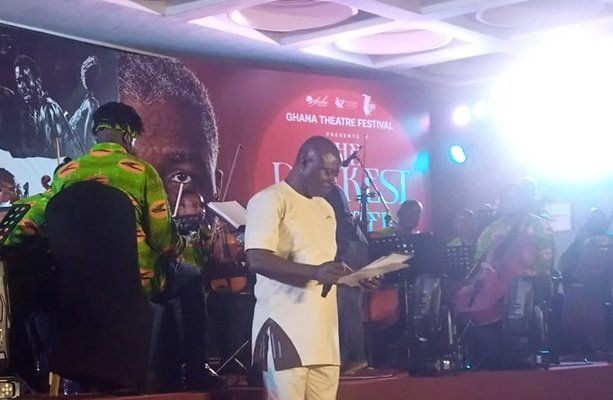
The Acting Executive Director of the National Theatre, Mr Henry Herbert Halm, has called on Corporate Ghana to move beyond traditional corporate social responsibility (CSR) sponsorship and invest directly in Ghana’s creative arts industry to unlock its commercial potential and create sustainable jobs for the youth.
He said businesses needed to view the creative industry as a viable economic frontier rather than simply a beneficiary of corporate donations.
Mr Halm made the call at the Ghana Theatre Festival 2026 in Accra on Thursday, where he urged companies to become strategic investors and partners in the development of creative productions.
The festival, held under the theme, “Five Movements, One Story,” featured an open-air concert and other artistic performances. The event also coincided with International Music Day, a global celebration that highlights the power of music to bridge cultural divides, foster peace and celebrate shared humanity.
Mr Halm said greater private-sector investment in the performing arts could generate significant economic and social returns through cultural tourism, commercial opportunities, intellectual property development and the strengthening of Ghanaian brands.
He said the relationship between Corporate Ghana and the arts had for too long centred on sponsorship and CSR, stressing the need for companies to take a more strategic approach to investing in the sector.
“Do not just be our sponsors, be our investors,” he said.
Mr Halm explained that investment in the Ghana Theatre Festival, the National Symphony Orchestra and other productions would enable companies to participate in the creation of valuable creative intellectual property.
He said such partnerships could generate long-term commercial value, strengthen corporate brands and contribute to national development and the preservation of Ghana’s cultural identity.
Mr Halm noted that although the National Theatre had a statutory mandate to develop, promote and preserve the performing arts, the responsibility for sustaining the sector could not rest solely with the State.
He said the performing arts offered opportunities to expand Ghana’s creative economy, attract cultural tourists and provide sustainable employment for young people, making stronger private-sector participation critical to the growth of the industry.
Mr Halm said the convergence of the Ghana Theatre Festival and International Music Day provided an opportunity to demonstrate how different artistic disciplines could come together to tell a unified story of Ghanaian identity.
He also highlighted the historical significance of the National Symphony Orchestra, which was established under the vision of Ghana’s first President, Osagyefo Dr Kwame Nkrumah, to indigenise symphonic music by blending orchestral structures with African musical traditions.
He said the orchestra and the festival demonstrated that Ghanaian cultural heritage could be presented on the global stage without losing its local identity.
Mr Halm, therefore, urged Corporate Ghana to collaborate with the National Theatre to develop new narratives, promote Ghanaian excellence internationally and preserve the country’s cultural heritage.
He said the ultimate goal was to build a sustainable creative industry in which cultural preservation and commercial investment worked together to benefit businesses, artists and society.
BY EUGENE AMPIAW
Read the *Ghanaian Times* and *The Spectator* newspapers digitally on [TimesNewsPlus](https://timesnewsplus.com/newspapers).
Follow our WhatsApp Channel now! https://whatsapp.com/channel/0029VbAjG7g3gvWajUAEX12Q

