


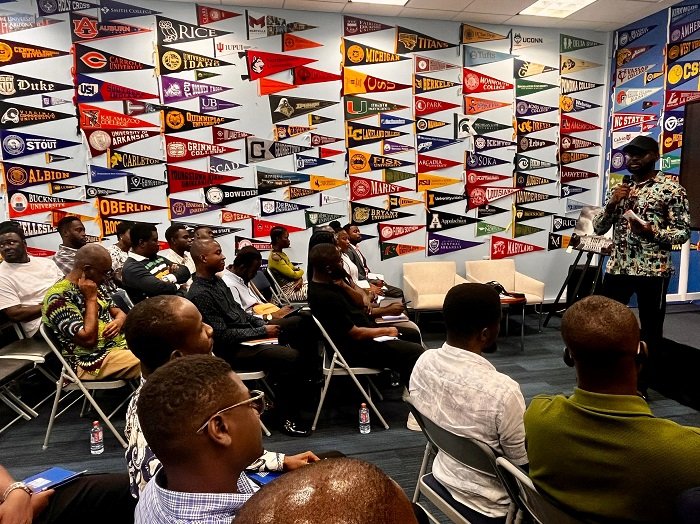
A World Cup Programming series event has been held at the American Centre in Accra to showcase the experiences of Ghanaian participants in the U.S. State Department’s International Visitor Leadership Program (IVLP).
The programme, organised on Wednesday by the U.S. Embassy in Ghana, aims to strengthen cross-cultural understanding ahead of the 2026 FIFA World Cup, to be hosted in 11 U.S. cities alongside venues in Canada and Mexico.
Titled “Countdown to World Cup 26: Telling the Story of American Cities through Photojournalism,” the event also featured a photographic exhibition of various U.S. cities through the lens of a Ghanaian photojournalist and IVLP alumnus, Gerard Nartey.
Speaking at the event, the Press Attaché at the U.S. Embassy in Accra, Mr Matthew Asada, said one of the most remarkable ways to experience America was through the perspectives of Ghanaians who have participated in U.S. cultural exchange programmes.
He noted that the IVLP, the U.S.’s premier exchange platform, allowed professionals in diverse fields to travel across America, meet their counterparts, and share knowledge that fosters mutual appreciation between nations.
Mr Nartey in his presentation warned that Ghana risked losing an accurate record of its heritage unless citizens deliberately photograph and document everyday life in their families and communities.
He said photographs and visual stories provide a more reliable record than memory or hearsay, urging Ghanaians to capture neighbourhoods, routines, and festivals “so tomorrow we can look back at today.”
Recounting his IVLP journey, Mr Nartey said the programme began in Washington, D.C., with orientation on press freedom and the First Amendment, journalistic ethics, and cultural sensitivity. Engaging with a multinational cohort and U.S. journalists, including freelancers who fund passion projects through grants and pitches, broadened his understanding of how rights and responsibilities are applied across contexts.
He highlighted lessons from community and cultural spaces such as Echo Park in Maryland, now a hub for photography learning and exhibitions, and from mentoring sessions encouraging children to build visual stories.
A visit to the Library of Congress, he said, underscored how well-kept photo archives validate the craft and preserve national memory.
In Reno, Nevada, he explored how the city’s transformation from a mining hub to an entertainment centre had been carefully recorded through images and local records, offering a model for documenting Ghana’s urban change.
He contrasted slower-paced cities with fast-moving Chicago, noting how environment shapes storytelling.
On technology, Mr Nartey said AI tools could help photographers cull images, generate captions, and design layouts, easing workloads without replacing authentic human storytelling.
“If we don’t document our spaces, our families, and our culture now, we risk losing them,” he stressed.
He urged individuals, creatives, and journalists to consistently tell stories and document their work through photographs, explaining that such records not only preserve culture and memory but also position them for future opportunities
BY STEPHANIE BIRIKORANG