


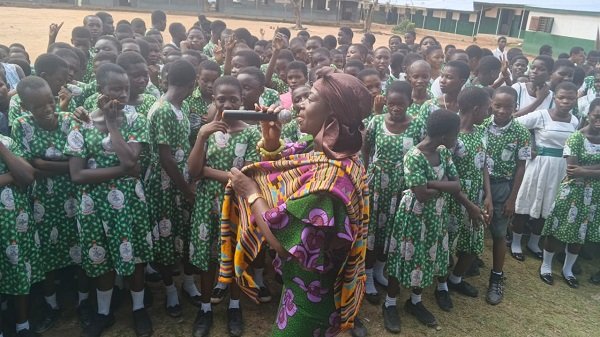
The Queenmother of the Apremdo Traditional Area in the Western Region, Nana Mozu VIII, has expressed concern about the rising incidence of cyberbullying among the youth, describing it as a threat to society.
She noted that the internet had increasingly become a platform for bullying, blackmail and sextortion.
Nana Mozu made these remarks at the 2026 Citizenship Week celebration organised by the National Commission for Civic Education (NCCE), which ended yesterday in Takoradi.
The event was held on the theme: ‘Upholding Our Constitution in the Digital Age: Our Collective Responsibility’, with a sub-theme: ‘Growing Up Digital: The Ghanaian Child Upholding the Constitution Online.’
Interacting with students of Apremdo Catholic School, she identified the increased use of social media platforms where users could communicate anonymously as a major cause of cyberbullying.
She explained that such anonymity allowed individuals to harass, threaten, embarrass or harm others.
Unlike traditional bullying, Nana Mozu said, cyberbullying could occur at any time and spread rapidly to a wide audience via the internet.
She emphasised that the trend had become a major concern for young people, schools, families and governments worldwide.
She acknowledged that social media has many advantages, including information sharing, research, communication, entertainment and online marketing.
Advising students to focus on their studies, the Queenmother urged them to desist from sharing nude images or videos, engaging in internet fraud, forming fake online relationships, and manipulating others through the use of fake accounts.
She observed that some individuals engage in cyberbullying due to peer pressure, jealousy, revenge or anger, often feeling protected behind screens and fake identities.
Nana Mozu further noted that lack of parental supervision contributes to the problem, adding that in extreme cases, cyberbullying has led to self-harm and suicide.
She advised students to use strong passwords, enable two-factor authentication, be cautious when communicating with strangers online, and report suspicious activities to school authorities or law enforcement agencies.
She also encouraged them to contact the Ghana Cyber Security Authority via the short code 292 for assistance.
The Regional Director of the NCCE, Mr Andrews Ofori Larbi, explained that sustaining Ghana’s Constitution depends not only on state institutions but also on raising citizens who understand their rights and responsibilities from an early age.
He noted that the Citizenship Week Celebration (CWC), instituted by the NCCE, had over the years become a practical platform for promoting civic awareness among schoolchildren and helping them understand governance, citizenship and their role in national development.
Mr Larbi added that the responsibilities of the youth now extend into the digital space, as children in Ghana are increasingly active online through smartphones, social media, e-learning platforms and gaming.
“The future of Ghana’s democracy depends on how well today’s children understand and live the values of the Constitution. Citizenship is no longer only about physical spaces; it is also about how we behave online. The 2026 Citizenship Week places children at the centre—not just as learners, but as voices of responsibility and change,” he stressed.
FROM CLEMENT ADZEI BOYE, TAKORADI
Follow our WhatsApp Channel now! https://whatsapp.com/channel/0029VbAjG7g3gvWajUAEX12Q

