


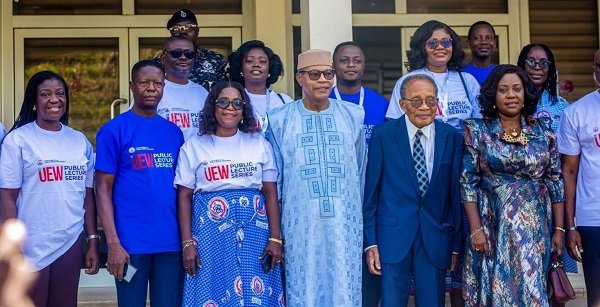
THE African Union High Representative for Silencing the Guns, Dr Mohamed Ibn Chambas, has called on African leaders, particularly Ghana, to adopt a holistic approach to addressing challenges in the education sector.
He said reimagining education was critical to empowering the human mind with creativity, critical thinking and ethical depth, which are essential for sustainable national development.
“Let us commit not just to reforming education but to reimagining it, for in the empowered mind of the child lies the blueprint for national transformation,” he said.
Dr Chambas made the call at the second University of Education, Winneba (UEW) Public Lecture Series held at the Jophus Anamuah-Mensah Conference Centre at the university’s North Campus on Friday.
The lecture, on the theme “Empowering minds: Rethinking education for sustainable development,” formed part of UEW’s efforts to promote dialogue on critical issues affecting national development.
He identified persistent challenges in the education sector, including policy inconsistencies, teacher remuneration, regional disparities, and the need to balance STEM education with the humanities, all of which, he said, required sustained attention.
Dr Chambas stressed the need to leverage technology to bridge the rural-urban divide, ensuring that children in remote communities had equal access to digital learning resources as their counterparts in urban areas.
He also called for increased and sustained investment in education, particularly in teacher development, describing teachers as key drivers of change.
“If we want empowered minds, we must have empowered, well-motivated and highly respected teachers,” he said.
Dr Chambas further urged stronger collaboration between government, the private sector and educational institutions to support innovation, research and skills development.
He said such partnerships would help align curricula with labour market needs and strengthen the country’s capacity to produce a skilled workforce.
He also encouraged parents and communities to broaden their definition of success, urging them to value diverse talents beyond academic achievement.
“Celebrate the child who excels in woodwork, robotics, agriculture and the creative arts,” he said.
The Vice-Chancellor of UEW, Professor Stephen Jobson Mitchual, said tertiary institutions must prioritise the training of students with employable skills to help address unemployment.
He noted that education must remain relevant, inclusive and responsive to the evolving needs of society.
The Special Advisor to the Minister of Education, Professor George K. T. Oduro, stressed the importance of nurturing both intellectual capacity and character development in learners.
The Chief Executive of Telecel Ghana, Mrs Patricia Obo-Nai, who chaired the event, commended UEW for promoting critical discussions on national development.
She warned that failure to align education with global trends could widen the gap between learning and employability.
The Chairperson of the UEW Lecture Series, Professor Mavis Amo-Mensah, described the event as successful and commended participants for their contributions.
FROM DAVID O. YARBOI-TETTEH, WINNEBA
Follow our WhatsApp Channel now! https://whatsapp.com/channel/0029VbAjG7g3gvWajUAEX12Q

