


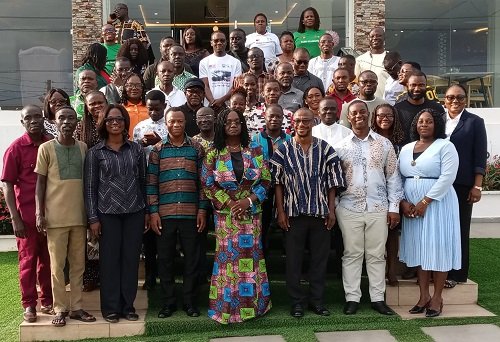
Members of the Ghana Journalists Association (GJA) in the Eastern Region have participated in a two-day training workshop in Koforidua aimed at strengthening media reporting on green innovation and sustainable development.
The workshop was organised by the University of Environment and Sustainable Development (UESD) through its Nkabom Collaborative, in partnership with the Mastercard Foundation, under the theme: ‘Reporting Green Innovation: Strengthening Media Engagement for Sustainable Development.’
The training equipped participants with the knowledge and skills to produce accurate, evidence-based and impactful reports on environmental sustainability, climate resilience and inclusive development.
Speaking at the opening ceremony last Wednesday, the Registrar of UESD and Project Administrator of the Nkabom Collaborative, Mrs Mary Abena Agyepong, said the media remained one of the most influential institutions in shaping public understanding, influencing policy discussions and promoting behavioural change.
She noted that as the world grappled with climate change, biodiversity loss, pollution and food insecurity, credible reporting on green innovation had become increasingly important.
Mrs Agyepong explained that the training was designed to enhance journalists’ capacity to identify, understand and effectively communicate stories on innovations that promote environmental sustainability and climate resilience.
She added that quality reporting would not only increase public awareness of sustainable practices but also provide policymakers with reliable information for decision-making, while giving innovators the visibility needed to scale up their solutions.
She reaffirmed the commitment of the Nkabom Collaborative to strengthening partnerships among academia, industry, government, civil society organisations and the media to address sustainable development challenges.
For his part, the Vice-Chancellor of UESD and Principal Investigator of the Nkabom Collaborative, Professor Eric Nyarko-Sampson, said the training formed part of activities under the collaborative, a partnership involving UESD, the University of Ghana, Kwame Nkrumah University of Science and Technology (KNUST), the University of Health and Allied Sciences, Ashesi University, the Association of Ghana Industries and McGill University.
He said the Mastercard Foundation-supported initiative sought to equip 55,000 Ghanaian youth, particularly women and other vulnerable groups, with skills in entrepreneurship, agro-waste management and aquaculture, while promoting innovation-driven solutions for sustainable development.
Professor Nyarko-Sampson explained that the collaborative was implementing an Agro-Waste Management and Aquaculture Technology Entrepreneurship Initiative to transform agricultural waste into valuable products while equipping young people with business and entrepreneurial skills.
He observed that large quantities of agricultural produce were lost through post-harvest losses, although many of the discarded materials could be processed into marketable products.
Using mangoes as an example, he said fruits rejected by commercial buyers often went to waste despite their potential value, explaining that mango seeds could be processed into butter, while the peels could be converted into other useful products.
Also speaking, the Pro-Vice-Chancellor of UESD and Project Coordinator of the Nkabom Collaborative, Professor Edward Debrah Wiafe, said the increasing volume of agricultural waste in the country required innovative solutions.
FROM AMA TEKYIWAA AMPADU AGYEMAN, KOFORIDUA
Follow our WhatsApp Channel now! https://whatsapp.com/channel/0029VbAjG7g3gvWajUAEX12Q

