


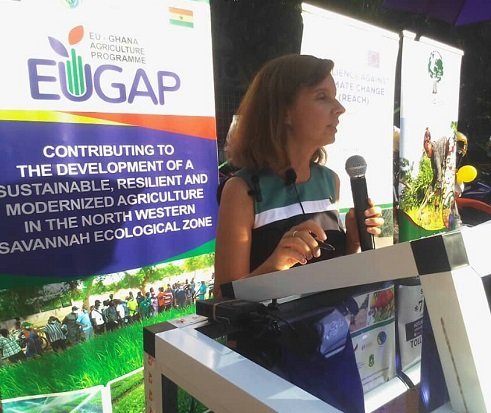
Hundreds of farmers in Northern Ghana are recording improved yields and year-round incomes following the completion of a climate resilience project funded by the European Union and the German government.
The Resilience Against Climate Change (REACH) project, implemented by Deutsche Gesellschaft für Internationale Zusammenarbeit (GIZ) under the European Union Ghana Agriculture Programme, has since 2020 supported smallholder farmers to adapt to climate change, improve food systems and strengthen local planning.
The initiative was funded by Germany through the German Federal Ministry for Economic Cooperation and Development.
Closing activities took officials to beneficiary communities including Buka, Babile, Duori and Duang, and ended with a ceremony in Wa.
Speaking at the event, Head of Infrastructure and Sustainable Development at the EU Delegation to Ghana, Paulina Rozycka, stressed the urgency of building resilient agricultural systems.
“Climate change does not respect borders. Its effects are felt most acutely by those who depend directly on the land,” she said.
She noted that the intervention forms part of broader efforts to promote climate-resilient agriculture across northern Ghana.
In Duori, one of the project’s key achievements is a 200-metre irrigation canal that channels water from a local dam to farmlands. Before the intervention, farming largely ceased during the dry season.
Currently, about 100 households cultivate vegetables such as cabbage throughout the year on nearly 100 acres, ensuring steady income and improved food supply.
The project adopted a participatory approach, enabling residents to identify priority needs through Community Action Planning. A local Water Users Association now manages the irrigation system.
In Duang, the project addressed post-harvest losses, a major challenge for farmers forced to sell produce at low prices immediately after harvest.
A solar-powered cold storage facility with capacity to preserve up to 10 tonnes of vegetables annually, including tomatoes, okra, green pepper and onions, has been installed.
Managed by a local committee and sustained through user fees, the facility allows farmers to store produce and sell when market conditions are favourable.
Another key intervention is the transformation of the Babile Agriculture Station in the Lawra District into a training hub for farmers and extension officers.
The centre now includes a 12-bed hostel, a 15-acre conservation agriculture demonstration field, solar-powered boreholes, a rehabilitated dam and mechanised equipment.
More than 1,000 farmers and extension officers have received practical training in sustainable farming practices.
The closing ceremony brought together farmers, assembly members and officials from the Ministry of Food and Agriculture to assess the project’s impact.
Although the REACH project has ended, its infrastructure and training systems are expected to continue benefiting communities, with local authorities tasked to maintain the facilities.
FROM NAZIRU ALHASSAN, WA
Follow our WhatsApp Channel now! https://whatsapp.com/channel/0029VbAjG7g3gvWajUAEX12Q

