


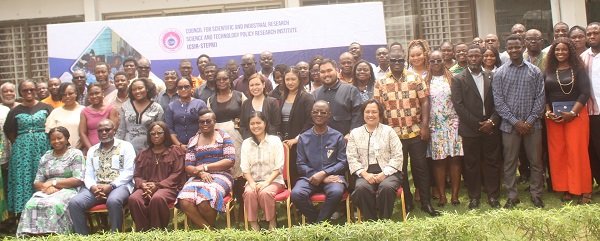
A one-day workshop to deepen public understanding of Solar Radiation Modification (SRM) as a tool to combat global warming was held in Accra yesterday, with experts urging caution and stronger governance around the emerging technology.
The workshop presented findings from the AskGOVSRM-Ghana Project, a two-year research initiative funded by the Degrees Initiative and implemented by the Council for Scientific and Industrial Research’s Science and Technology Policy Research Institute (CSIR-STEPRI), in collaboration with the University of Cape Coast (UCC) and the University of Health and Allied Sciences (UHAS).
The project seeks to generate evidence to support informed, inclusive and responsible engagement on SRM, while identifying policy, institutional and research gaps to safeguard Ghana’s national interests.
Opening the workshop, the Minister of State in charge of Climate Change and Sustainability, Alhaji Baba Issifu, whose speech was read on his behalf, described the dialogue as timely and necessary.
He stressed that emerging climate technologies must be approached with sound knowledge, strong governance and ethical responsibility.
He explained that although SRM was attracting global attention due to its potential to temporarily lower temperatures by reflecting a fraction of sunlight back into space, it could not replace efforts to reduce greenhouse gas emissions.
Ghana’s priority, he said, remained emission reduction, climate adaptation, ecosystem restoration, renewable energy expansion and the building of resilient communities.
He added that the country could not afford to be absent from international discussions on technologies with possible cross-border implications.
The minister commended the researchers for assessing Ghana’s governance readiness and stakeholder perceptions, noting that the findings would help strengthen national institutions and enhance the country’s contribution to global climate governance discussions.
Presenting the scientific findings, a Senior Lecturer at the University of Cape Coast, Dr Francis Nkrumah, explained that SRM sought to replicate the cooling effect observed after the 1991 eruption of Mount Pinatubo, when particles released into the upper atmosphere reflected sunlight and temporarily cooled the Earth.
He said while research suggested SRM could reduce global temperatures faster than emission cuts alone, it did not remove carbon dioxide from the atmosphere, address ocean acidification or replace mitigation measures.
Dr Nkrumah noted that studies across Africa indicated that although SRM could offset projected warming, its impact on rainfall, agriculture, water resources and air quality remained uncertain.
He explained that some regions could become drier, while others might experience increased rainfall.
Dr Nkrumah said science could project potential temperature and rainfall outcomes, but could not determine whether the technology was fair, acceptable or appropriate, describing those as governance and ethical questions requiring broad public engagement.
Also speaking, adviser to the chair of the Africa Group of Negotiators, Dr George Manful, called for a clear governance framework before any decisions on SRM research or deployment.
He urged Ghana to establish strong scientific and ethical safeguards, promote transparency, ensure meaningful public participation and strengthen regional cooperation.
Dr Manful stressed that Africa must not become a testing ground for emerging technologies developed elsewhere.
A representative of the Ministry of Environment, Science and Technology, Mr Raymond Ohene Ofori, said Ghana already had strong climate policy frameworks but acknowledged that none specifically addressed SRM.
He said the ministry expected the project’s findings to inform future policy discussions, particularly the implementation of the National Adaptation Plan and the Environmental Protection Act.
The Engagement Director of the Degrees Initiative, Mr Marcos Regis da Silva, said although Africa contributed less to climate change, it bore a disproportionate share of its impact.
He said SRM could play a role in mitigating climate change effects and reducing global warming.
BY KINGSLEY ASARE
ollow our WhatsApp Channel now! https://whatsapp.com/channel/0029VbAjG7g3gvWajUAEX12Q

