


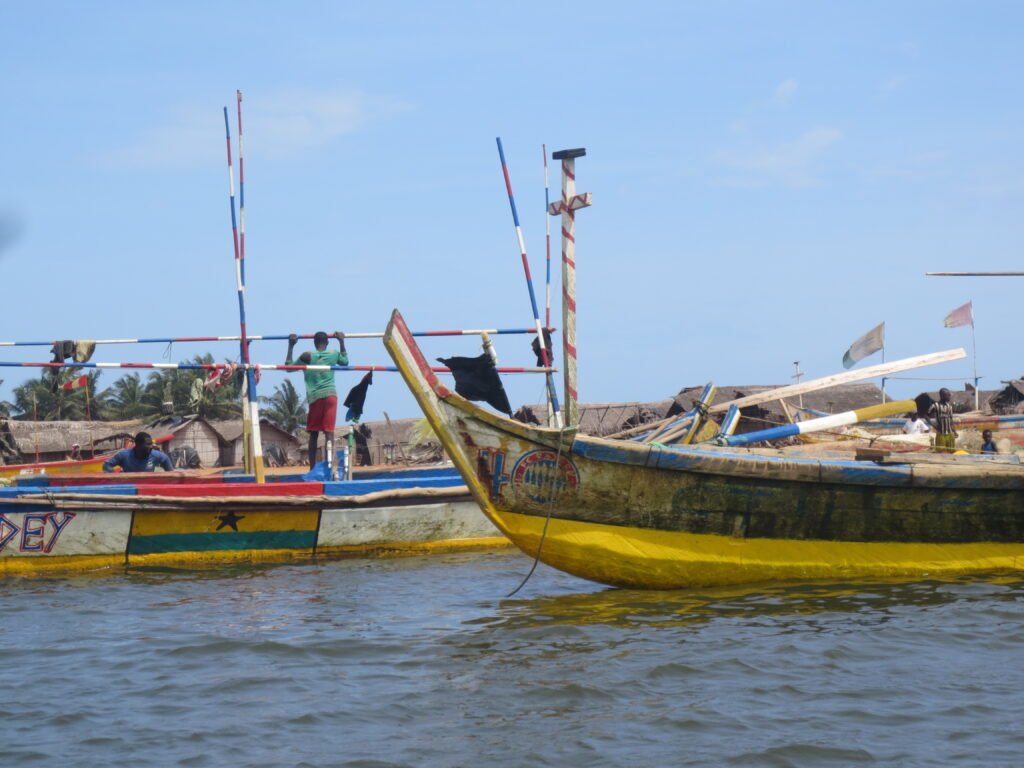
The fisheries sector is a significant source of food and nutritional security; job and wealth creation in Ghana; and very important in attaining socioeconomic growth and the United Nation’s Sustainable Development Goals, particularly goals; 1. End poverty, 2. End hunger, and achieve food security, 3. Good health and wellbeing, and 14. Conserve and sustainably use oceans, seas and marine resources.
This sector provides livelihoods for an estimated three million of the population and has the potential to create economic opportunities for more than five million people by 2030. Fish forms 60 per cent of animal protein intake since the last decade; per capita consumption is about 25kilogrammes (kg), which is significantly higher than average fish consumption in the ECOWAS region.
Ghana’s fishing sector
faces challenges,
including but not limited
to;
1. Overfishing: Due to poor ocean governance, and has resulted in decline of many fish species like Sardinella, Anchovy, etc.
2. Illegal, Unreported, and Unregulated (IUU) Fishing; activities such as fishing without appropriate licenses, using banned fishing gear, and underreporting catches.
3. Environmental Degradation; surveys conducted by scientists at the Fisheries Commission (FC) shows rising sea temperatures, ocean acidification, and habitat destruction that could have long-term effect on productivity and distribution of fish populations.
These challenges require key measures to regenerate and sustainably manage fisheries resources. In 2016, stakeholders agreed and instituted the Closed Fishing Season in accordance with Section 84 of the Fisheries Act 2002 (Act 625), which “mandates the Fisheries Commission (FC) to declare a closing period, including timelines, to suspend fishing in coastal waters or riverine systems.”
Closed season
The Ministry of Fisheries and Aquaculture Development (MoFAD) and FC implements the closed fishing season for artisanal, industrial and semi-industrial fleets from, July 1 to 31 for artisanal fishers; and July 1 to August 31 for semi-industrial and industrial trawlers. This period is naturally the reproduction season and recruitment of fish stock.
The core principles of the policy are to “optimise the spawning potential of the fisheries, increase the biomass and yield of both small pelagic and demersal species, and enhance the benefits of fisheries resource for food security.”
Biological studies and catch rates analyses conducted by the Fisheries Scientific Survey Division (FSSD) between June and October 2023 show the mean size of fish was 24cm, which is above the minimum allowable landing size; and proportional increase in mean catch per trip from 8kg to 60kg. The most important measure to consider when making fisheries management decisions to prevent vulnerable catch is Fish Recruitment; this was recorded to be 76%, indicating high transition into fish stock after the closed season.
Exemption of artisanal
fishers
The government has announced exemption of artisanal fishers from this year’s Closed Season without any justification or scientific data backing the directive. Experts whose advice have been completely disregarded say, “perhaps the Minister and President have done their own research to back the decision; would they share the data so everyone analyse!”
Although there are other measures like canoe reclassification to cap size and moratorium on canoe construction to reduce tree felling, there is high risk for allowing artisanal fishers who form about 85% of fishers to harvest small pelagic during spawning period.
Putting a moratorium on canoe tackles the problem of overcapacity in the sector. Ideally, Ghana’s Exclusive Economic Zone (EEZ) can contain about 9,000 canoes; however, there are 14,000 registered canoes according to the 2022 Canoe Survey Report. Also, 70 per cent of all reported catch is from artisanal fishers. Why would any policymaker exempt this group from closed fishing season? The Canoe Survey Report show that about 110,000 canoe fishermen
sweep the sea every week, therefore it is important to suspend fishing, especially between June and September, to allow spawning and fish recruitment.
On GPHA’s eye-on-port show, industry players showed data projection that exempting canoe fishers from closed season risks reducing landed fish from 96,000mt to 5,000mt by 2040. This decreases fisheries contribution to the economy, threaten nutritional and food security, and, in the end, the
government is giving fish-folk what they want today but rob them off what they need in the future.
Besides, managing the industrial and semi-industrial trawlers is not as difficult because the vessels have monitoring system for tracking navigation; there are surveillance cameras to track activities, and licensed to catch demersal fish. The main stay of the local fishery economy is small pelagic, which is in sharp decline since the last decade, and harvested by canoe fishermen whose activities cannot be easily monitored unlike trawlers.
To exempt artisanal fishers is to allow practices that undermine the directive principle of state “to protect and safeguard the sustainability of the environment for present and future generation.”
RECOMMENDATION
We are by this medium petitioning the Minister to peruse existing data that supports closed fishing season, and heed to the call of experts and stakeholders to rescind the directive. We recommend that the government should pursue other sources of job creation and livelihood empowerment such as aquaculture as an avenue to supplement shortfalls in fish requirement; it has an annual growth potential of 15 per cent and estimated to contribute about $314 million to the economy by 2028.
We must leverage on Artificial Intelligence and technology to model and transition to fibreglass boats, where electronic monitoring devices can be installed, to upscale at least 60 per cent of existing canoes by 2035, and create new economic pathways in the fishery value chain to support livelihoods in coastal communities.
In conclusion, food and nutritional security, economic empowerment and environmental conservation are matters of great importance; we cannot keep mute about those whose actions or inaction could undermine their sustainability. The principle of good governance must be upheld at all times, not sometimes.
We call on government to revise the directive to exempt artisanal fishers from closed fishing season.
The writer is the Director, Sane Shores Initiative (NG)
BY NANA BENYIN QUAISON