


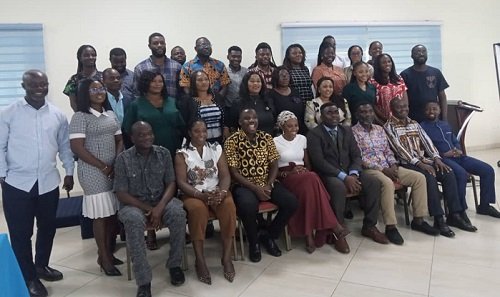
The Head of the Department of Communication Studies at the University of Professional Studies, Accra (UPSA), Prof. Adwoa Sikayena, yesterday emphasised the importance of digital and social media in enhancing government communication strategies.
She has therefore called on managers of government communication to focus on digital media to help bridge engagement gaps with their stakeholders.
Speaking at a two-day training workshop for Public Relations Officers (PROs) of the Ministry of Education in Accra on Thursday, Prof. Adwoa Sikayena said the critical role of digital and social media made it imperative.
According to her, the Ministry’s focus on digital media would help bridge engagement gaps with stakeholders who may not always attend in-person meetings.
Prof. Sikayena described the training as timely, explaining that young people, who constituted a significant proportion of Ghana’s population, were predominantly active online.
She recommended that such workshops be held at least twice a year to keep PR practitioners aligned with global best practices and abreast of evolving trends in communication.
“Sometimes new developments emerge, and PR officers must be quickly reoriented to manage them effectively,” she said.
Prof. Sikayena commended the Ministry of Education for its initiatives aimed at addressing sensitive issues, including efforts to reintegrate children from illegal mining communities into school.
She urged that such interventions be amplified through digital storytelling to showcase real human impact.
On challenges facing public sector PR, she observed that communication units are often seen as focusing more on officialdom rather than addressing issues of direct concern to citizens.
She therefore encouraged PR practitioners to adopt feedback loops, FAQs, and sentiment analysis tools to better capture and respond to public expectations.
“PR must go beyond damage control to proactive, issues-based campaigns that build trust and goodwill,” Prof. Sikayena concluded.
Meanwhile, a lecturer at the University of Media, Arts and Communication (UNIMAC), Dr Martin Thompson Ntem, has called for a deliberate national shift towards skills-based hiring and continuous professional development.
Dr Ntem noted that while automation, artificial intelligence (AI), and big data are transforming workplaces, human expertise remains indispensable.
He stressed that organisations are increasingly looking for employees with a blend of technical and soft skills. “It is no longer enough to rely on academic degrees. Employers are asking, what else can you do?” he remarked.
Dr Ntem highlighted critical competencies such as data analysis, AI, and project management, as well as soft skills including emotional intelligence, reasoning, and adaptability.
He urged professionals to take advantage of short courses and continuous training to stay relevant in a competitive labour market.
According to him, the future of work will be defined by lifelong learning, remote working, and collaboration powered by digital tools.
Both speakers emphasised that strengthening communication and skills development is vital to Ghana’s progress in an era where technology and human adaptability are shaping the future.
BY EUGENE AMPIAW