


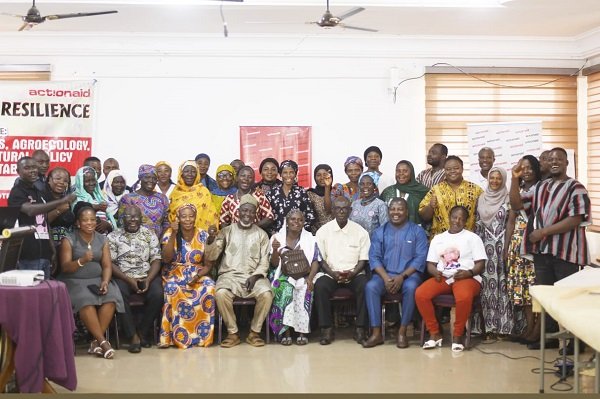
STAKEHOLDERS in the agricultural sector have called for the formulation and implementation of stronger national policies to promote food sovereignty, empower women farmers, and enhance food production in the country.
The call was made at a conference organised by ActionAid Ghana in Tamale yesterday. The event brought together participants from five regions across Northern Ghana, with a focus on women smallholder farmers.
Addressing participants, the Women’s Rights Manager at ActionAid Ghana, Ms Eugenia Ayishetu Ayagiba, expressed concern over Ghana’s continued reliance on neighbouring countries for essential food commodities such as tomatoes and onions.
She described the situation as unacceptable for a country endowed with vast agricultural potential and underscored the need for deliberate efforts to achieve food self-sufficiency.
“Considering recent developments, particularly our dependence on neighbouring countries for basic food items, it is not appropriate for a country like Ghana to rely on others to feed its people,” she stated.
Ms Ayagiba acknowledged government efforts to improve the agricultural sector but stressed that more needed to be done to reduce import dependence and strengthen local production systems. She noted that initiatives such as school farming and poultry projects were commendable but required scaling up.
She explained that the conference aimed to influence national agricultural policies to ensure sustainable food systems through the promotion of food sovereignty.
“The purpose of the conference is to promote food sovereignty so that we can feed ourselves as a nation instead of depending on other countries,” she added.
She further indicated that the programme sought to address harmful agricultural practices while promoting safer and more sustainable food production methods, particularly among women farmers.
According to her, the promotion of agroecology remains critical to achieving sustainable agriculture, as it will not only influence policy direction but also strengthen the role of women within farming systems.
The Head of Programmes, Campaigns and Innovations at ActionAid Ghana, Mr Justin Bayor, said the conference formed part of the organisation’s strategic priorities aimed at strengthening local agricultural systems and supporting vulnerable farming communities.
He noted that the event underscored the critical role of women in agriculture and the need for inclusive policies and sustainable practices to ensure long-term food security in Ghana.
The Principal Planning Officer at the Northern Regional Coordinating Council, Mr Eric Ofori Arthur, highlighted the relationship between food and public health, stressing that many health conditions are linked to poor dietary practices.
“Conferences of this nature are essential in addressing the quality of food we consume, particularly through the adoption of agroecological practices,” he said.
Mr Ofori Arthur called on traditional authorities and community leaders to make available fertile lands to women and support them with inputs and other resources to enhance agricultural productivity.
He added that such interventions would contribute to increased food production and complement government efforts to ensure food security.
He further urged effective collaboration among stakeholders across various sectors to address the country’s food challenges.
A participant, Madam Grace Adah, a smallholder farmer from Banda in the Bono Region, commended the initiative, describing it as a valuable platform for knowledge sharing and capacity building.
“Programmes like this enable us to learn from one another and improve our farming practices,” she said. “I believe Ghana can feed itself if priority is given to supporting smallholder farmers, especially women.”
FROM: GEOFFREY BUTA, TAMALE
Follow our WhatsApp Channel now! https://whatsapp.com/channel/0029VbAjG7g3gvWajUAEX12Q

