


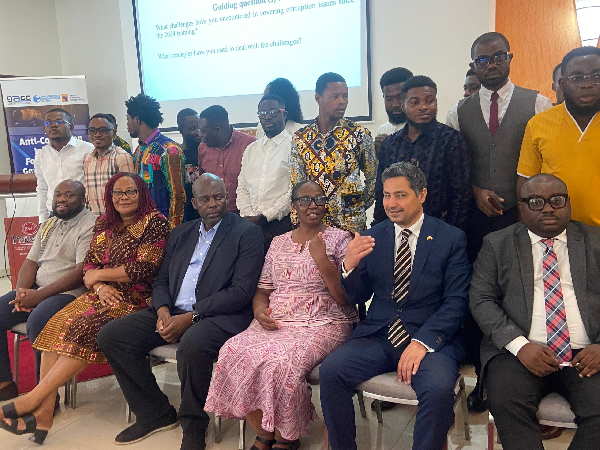
A day’s workshop to equip journalists with skills for effective reporting on governance and corruption issues in Ghana has been held in Accra yesterday.
Organised by the Ghana Anti-Corruption Coalition (GACC), in partnership with the Africa Centre for Energy Policy (ACEP), the programme brought together media practitioners, civil society actors and government representatives, among others, to build capacity for promoting accountability in the country.
The workshop formed part of the “Anti-Corruption for Enhancing Governance and Accountability in Ghana” project, which seeks to strengthen public financial management, increase transparency, and enhance citizen oversight in local governance.
In his remarks, the Project Director of Democracy Project, a non-profit organisation, Dr John Osae-Kwapong, expressed concern about Ghana’s weak fight against corruption despite its recent score on the Corruption Perceptions Index (CPI).
He cited findings from Afrobarometer and the Mo Ibrahim Foundation Index, which raise strong concerns about weak accountability and procurement systems, as well as institutional gaps that continue to fuel corruption in the country.
“Data from the National Commission for Civic Education (NCCE) further reveal a troubling trend where about one-third of Ghanaians believe that paying a bribe for entitled services is not wrong, and two in 10 people see nothing improper with public officials using their positions to benefit relatives and associates,” he disclosed.
Dr Osae-Kwapong emphasised the need for a collaborative approach to addressing corruption and governance challenges, calling for sustained civic education and moral reorientation to tackle the canker.
The Executive Secretary of the GACC, Mrs Beauty Emefa Narteh, urged participants to take advantage of the insights gained from the workshop to improve their accountability, while also holding duty bearers accountable.
“Accountability is key because if somebody invests in you and you cannot demonstrate the investment in terms of how it has impacted or influenced your skills, it means there is no value for money. We hope this training enhances your reportage as key stakeholders in the fight against corruption so that together we can build a better Ghana,” she underlined.
The Policy Lead for Petroleum and Conventional Energy at ACEP, Mr Kodzo Yaotse, noted that corruption reporting, particularly in technical sectors such as the extractive industry, requires specialised knowledge, hence the need for continuous training of journalists.
He stressed that a strong, independent and ethical media remains one of the most effective tools in combating corruption.
BY ABIGAIL ANNOH & AGNES OWUSU
Join our WhatsApp Channel now! https://whatsapp.com/channel/0029VbAjG7g3gvWajUAEX12Q


Follow the latest videos and updates on the official YouTube channel of Ghanaian Times.