


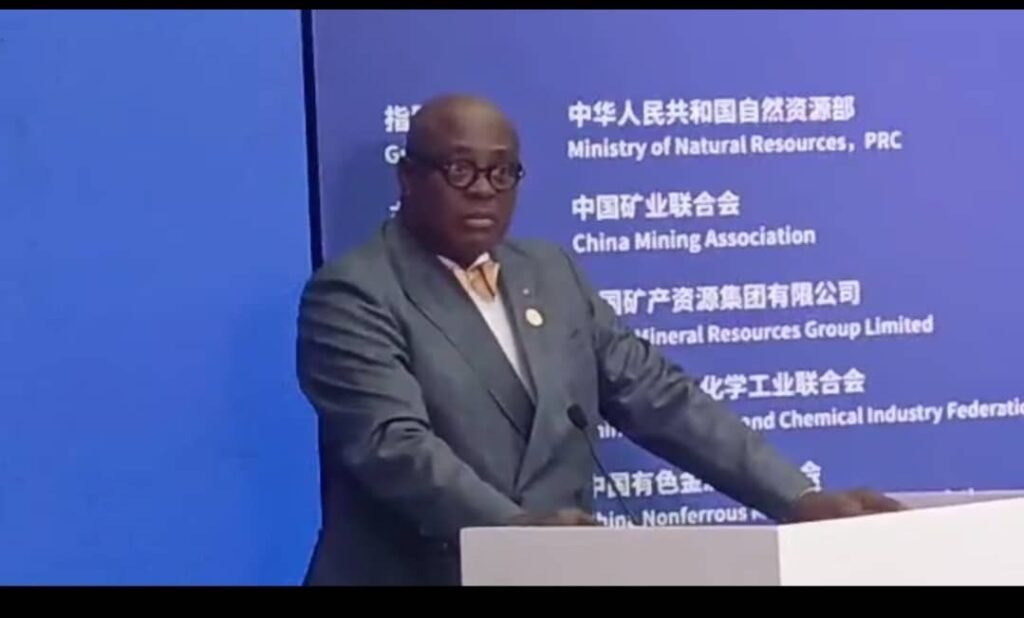
Ghana has reaffirmed its commitment to adding value to its mineral resources locally, with the government positioning beneficiation as a key strategy to create jobs, develop skills and maximise the economic benefits of mining, Ghana’s Ambassador to China, Kojo Bonsu.
He said the government was ready to work with investors who aligned with President John Dramani Mahama’s policy direction of ensuring that more value was derived from the country’s mineral resources.
Addressing investors at this year’s China Mining Conference in Tianjin, China, on Friday, Mr Bonsu said the government’s policy was firmly focused on local beneficiation, including refining bauxite into alumina and developing the country’s mineral processing capacity.
He said Ghana had made a deliberate decision to move away from exporting raw minerals and subsequently importing finished products at higher costs.
“Ghana has made a clear and deliberate choice that we will no longer be content to explore raw ore and import back finished products at higher prices. It is not good,” he said.
Mr Bonsu said the government was therefore putting in place the necessary frameworks, infrastructure and incentives to attract investment into mineral processing and ensure that mining generated greater benefits for the Ghanaian economy.
“We are building frameworks, infrastructure, and the incentives to give more value, more skills and more jobs,” he said.
He said the approach formed part of a broader effort by the Mahama administration to reposition mining from being primarily an extractive activity to becoming a central pillar of Ghana’s national development agenda.
He described the administration as one “that doesn’t see mining as an extractive afterthought but as a central pillar of our utilisation agenda under our unified national development priorities.”
The Ambassador, who has been associated with major development initiatives in Ghana, including the rebranding of Ghana Oil Company Limited (GOIL) and the construction of the Kejetia Market in Kumasi, described China as an important bilateral partner.
“China has been and remains Ghana’s significant partner on infrastructure, trade, and increasingly in the mining and minerals value chain,” he said.
Mr Bonsu encouraged Chinese investors to explore opportunities in Ghana and build partnerships that would deliver benefits to both countries.
“We are therefore here to present opportunities. Listen, negotiate, and build partnerships that are genuinely mutual and grounded in fair terms,” he said.
He called for greater technology transfer, local content development and shared prosperity as Ghana and China sought to deepen cooperation in the mining sector.
He also stressed the need for a transparent and improving regulatory environment, a skilled and youthful workforce, and a government that viewed mining as a catalyst for national development.
At the Ghana Forum, held as part of the conference, the Minister for Lands and Natural Resources, Emmanuel Armah-Kofi Buah, outlined some of the challenges confronting Ghana’s mining sector.
He identified gaps in geological information as a major challenge, saying the deficiencies were affecting efforts to adequately identify and explore the country’s mineral resources.
The Minister also highlighted regulatory reforms and the establishment of the National Anti-Illegal Mining Operations Secretariat (NAIMOS) as part of measures to tackle illegal mining operations.
He said the government was also pursuing cooperative mining and introducing medium-scale mining as part of efforts to strengthen the sector, improve participation and promote greater value addition to Ghana’s mineral resources.