


EVERY successful expedition has its enemies.
Some lie ahead, waiting to ambush. Others travel with you. For Ghana’s Black Stars, the most dangerous opponent has often been the latter.
It does not wear Argentina’s sky blue. It does not wear Brazil’s famous yellow. It does not even wear England’s white. It wears Black Stars jerseys.
Nevertheless, Ghanaians expected little from the Black Stars at the 2026 FIFA World Cup. By the time the tournament kicked off, hope had become a scarce commodity.
Months of disappointing performances had stripped supporters of their usual optimism. Defeat had become so routine that many had resigned themselves to another forgettable campaign.
Pre-tournament losing streak between February and March rolled off with Japan (2-0), South Korea, (1-0), Austria (5-1) and Germany (2-1) with the last defeat triggering the sacking of Otto Addo – who had executed the team’s success to its fifth Mundial.
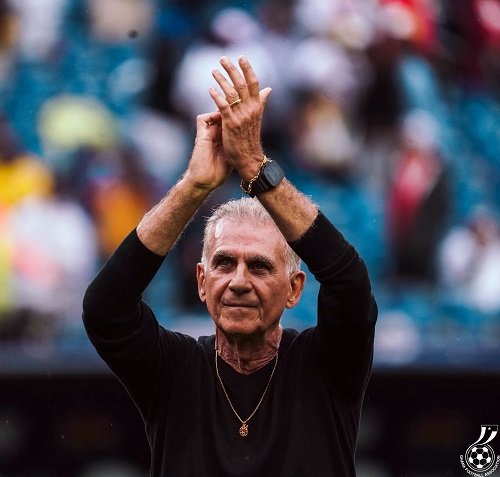
Veteran Portuguese coach Carlos Queiroz was hurriedly appointed to salvage what many believed was a sinking ship – and a target to guide Ghana to the last-eight, a feat the nation chalked at the 2010 tournament in South Africa.
Indeed, the exit of Addo was well-anticipated, having also failed to qualify Ghana to the 2025 Nations Cup, a tournament the Black Stars had never missed since the Tunisia 2004 fiasco.
Two more friendlies followed: A 2-0 loss to co-host Mexico (Queiroz not in charge) and 1-1 draw against Wales which the Portuguese supervised.
So, in all, Ghana played six pre-tournament games – winning none, drawing one, losing five and conceding an embarrassing 12 goals and scoring just a paltry three. This was the reason many threw their hands up in utter despondency even before the Stars’ first kick.
However, after Ghana’s nail-biting 1-0 victory over a rugged Panama side and a valiant 0-0 barren tie with England – that zipped up the terror of Harry Kane – screams of despair suddenly gave way to roars of optimism.
Upshot of the two games granted the Stars qualification into the next round with a game to spare.
The celebration was massive across the Diaspora and the streets of Ghana exploded in ecstasy. It is understandable.
A team that had utterly been written off was now becoming everybody’s dark-horse to upset the applecart. The tables seem to be turning faster than expected.
Out of excitement, Carlos Queiroz was hailed by some of the fans as the best thing to happen to Ghana in the last few months or so – having assumed the post barely two months to the tournament. But just!
With many experts of the game expecting Ghana to build up on that momentum, the Stars made heavy weather of themselves against Croatia in their third game, losing 2-1. The excuse was that the team did not need to over-exert themselves since qualification to the next round was already tucked under their armpits.
Unknown to many, trouble was silently brewing behind closed doors. A quiet storm was gathering – one that threatened to undo everything the team had worked so hard to achieve.
One of Ghana’s vivacious forwards – Brandon Thomas Asante – was alleged to have ‘badgered’ on Carlos Queiroz to give him enough playing time instead of the minutes allotted to him the last time.
That request, according to inside sources, got the Portuguese coach very upset, deciding to consign him to the bench in a ‘show of power.’ There were also reports of the player returning late to camp after the team had been given some ‘time-off’ – following the Panama victory.
Whether the reports were entirely accurate is almost beside the point. What mattered was the perception that yet another internal dispute had surfaced at the worst possible time.
The prolific Thomas-Asante, who fired 13 goals to propel English side Coventry City back to the Premiership this season, was introduced two minutes before the hour mark against Panama and made an instant impact, setting up Caleb Yirenkyi for the dramatic 95th-minute winner.
Like a sprinter released from the blocks. Thomas-Asante scampered down the left on top of an Antoine Semenyo perfectly weighted pass, outwitted his marker before calmly laying a dream assist across goal – which the young racing Yirenkyi finished with the aplomb of a veteran.
Ghana erupted. Car horns blared from Accra to Kumasi. Bars overflowed.
Fans poured into the streets wrapped in the national colours.
For a nation that had buried its expectations weeks earlier, belief had suddenly risen from the ashes.
Ever since, many Ghanaians have been itching to see more of Brandon, but the explosive substitute had suddenly vanished, whilst the Stars suffered in attack in their last three games.
Was he injured? Had he been dropped for tactical reasons? Or had something else happened behind closed doors?
Nobody seemed to know.
It was clear that the Stars played with little verve and zeal in their last two games, particularly in the Round of 32 1-0 loss to Colombia, where they stunningly failed to have a single shot on target in the entire duration.
There was no fight. No energy. No passion. No urgency. No belief. No character! These were remarkable attributes that freely characterised Ghana’s two opening games.
The team’s camp was in near disarray – and team spirit had taken a distressing nose-dive.
Questions are being asked: Was Brandon’s late reporting to camp so much a sin as to warrant a three-match ‘ban’ (270 minutes of football)? Admittedly, protocols in camp have to be respected; but could there not have been any other way of punishing him? Certainly, there is more to it than meet the eye.
Then, Coach Queiroz pops up.
In a post-match interview on why he gave Brandon little time, the Portuguese coach literally told Sporty FM that he did not deem it necessary, hence his decision to try other forwards.
It was an explanation that convinced few. If anything, it sounded like the first audible click of the self-destruct button.
You do not need to be a football expert to reckon something had gone amiss. Something, indeed, was awfully wrong!
Ghana’s decline had little to do with tactics or talent. It had become painfully familiar.
Just when the Black Stars appeared to have found their rhythm, they seemed to reach for the same button that has haunted so many promising campaigns.
For instance, in the 2022 World Cup in Qatar, there were lots of allegation of insubordination against Otto Addo in the team’s camp. Insiders believe the Stars’ early exit could partly be attributed to that.
Admirably, management of the Ghana team did tremendously well to ensure the tension in camp did not break through the roof. Media people close to the team also did their bit to tone down on all negativity.
Again, 12 years ago, Ghana’s team to the Brazil World Cup was described by the global media as fiery, combative, winsome and fully-loaded to take on the world.
Endowed by an embarrassing galaxy of huge talents including the prolific Asamoah Gyan, Michael Essien, Andre Ayew, Christian Atsu, Sulley Muntari, Kevin-prince Boateng, Mubarak Wakasu, Emmanuel Agyemang Badu, Samuel Inkoom, Kwadwo Asamoah, Harrison Afful – name them – the Black Stars were tipped to reach the semis – a stage they missed by a hair’s breadth at the 2010 edition in South Africa.
However, indiscipline, loss of focus and appearance fees brouhaha tore the team into ribbons, culminating in the sacking of Kevin Prince Boateng and Muntari from the team’s camp before their must-win third group game against Portugal. The result was obvious. They lost 2-1.
Remember, this was a team that had battled eventual winners – Germany – to an absorbing 2-2 draw in the second group game – an encounter they could have won if they had remained a bit composed in front of goal.
It is, therefore, worrying and mind-boggling that more than a decade after that heart-wrenching Brazil incident, the Ghana camp is still grasping with issues bordering on discipline, insubordination and to some extent – player selection.
The 2026 World Cup has come and gone for Ghana, leaving behind moments of courage, flashes of brilliance and, ultimately, another painful lesson.
Without any shred of doubt, Ghana has never lacked talent. From Abedi Pele to Stephen Appiah, from Asamoah Gyan to today’s emerging generation, the Black Stars have rarely lacked footballers capable of standing toe-to-toe with the world’s finest.
The recurring question has always been whether the team can conquer the battles that rage beyond the touchline.
Coaches will come and go. Players will retire. Administrators will change. Yet, unless Ghana finally confronts the culture that repeatedly allows avoidable distractions, internal disputes and indiscipline to derail promising campaigns, history will continue to repeat itself.
Opponents may defeat Ghana from time to time. But far too often, the Black Stars have beaten themselves.
Until the Stars learn to win the battles inside its own dressing room, the battles on the pitch will remain infinitely harder than they need to be.
For now, Ghana’s greatest opponent will remain the one staring back from the dressing-room mirror.
BY JOHN VIGAH
Follow our WhatsApp Channel now! https://whatsapp.com/channel/0029VbAjG7g3gvWajUAEX12Q

