


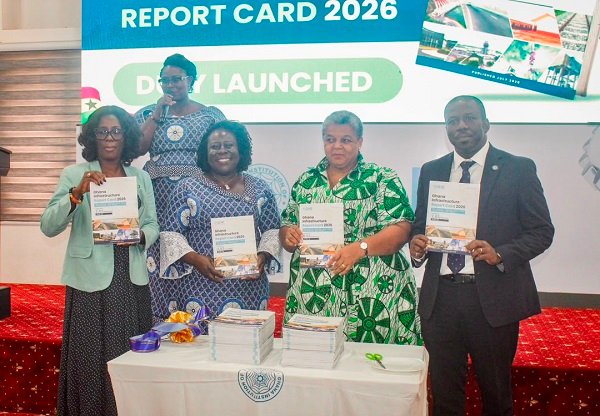
Ghana’s infrastructure has largely stagnated over the past decade, retaining a D3 grade equivalent to 57 per cent despite significant public investment, the 2026 Infrastructure Report Card has revealed.
The report, launched in Accra yesterday by the Ghana Institution of Engineering (GhIE), attributes the situation to inadequate maintenance, weak asset management and insufficient funding.
It highlights the road sector as recording the steepest decline, while health and rail infrastructure remain in poor condition.
At the launch, the Vice-President of GhIE, Dr Patrick Amoah Bekoe, explained that the report was an evidence-based public accountability tool developed from data gathered from ministries and state agencies between 2017 and 2025.
He said the assessment also incorporated responses from more than 900 engineering professionals and members of the public to ensure objectivity.
According to the report, the aviation sector emerged as the best-performing, scoring a C3 grade (71 per cent), while the electricity sector showed improvement due to increased generation capacity and better operation and maintenance practices.
In contrast, the road sector declined from D3 to E1, with both the health and rail sectors also scoring E1, representing 49 per cent and 48 per cent respectively.
Dr Bekoe further stated that Ghana currently produces only about 55 per cent of its daily water demand, with nearly half of all treated water lost through non-revenue water losses. As a result, about 3.7 million people do not have access to safe drinking water.
On education, he noted that although school enrolment has increased over the years, infrastructure investment remains inadequate.
He indicated that only about 10 per cent of education expenditure goes into infrastructure, leaving many schools without adequate classrooms, electricity, potable water, sanitation and ICT facilities.
Dr Bekoe attributed the persistent challenges across most sectors to inadequate funding, poor maintenance culture and weak asset management. He explained that successive governments had prioritised new projects over the maintenance of existing ones.
He, therefore, called for sustainable infrastructure financing, improved maintenance culture, data-driven asset management and the establishment of a National Infrastructure Authority to coordinate long-term planning.
The Minister for Works, Housing and Water Resources, Kenneth Gilbert Adjei, in a speech read on his behalf by his deputy and Member of Parliament for Awutu Senya West, Gizella Tetteh Agbotui, described the report as an important evidence-based tool to strengthen accountability and guide investment decisions.
He said the government remained committed to building resilient infrastructure through technology, innovation and stronger partnerships to support sustainable national development.
The President of GhIE, Ludwig Annang Hesse, said the report was intended to influence public policy and improve accountability in infrastructure delivery.
He urged government agencies to use the findings to inform policy and investment decisions, adding that the institution would publish the report every three years to track progress.
BY STEPHANIE BIRIKORANG
Follow our WhatsApp Channel now! https://whatsapp.com/channel/0029VbAjG7g3gvWajUAEX12Q

