


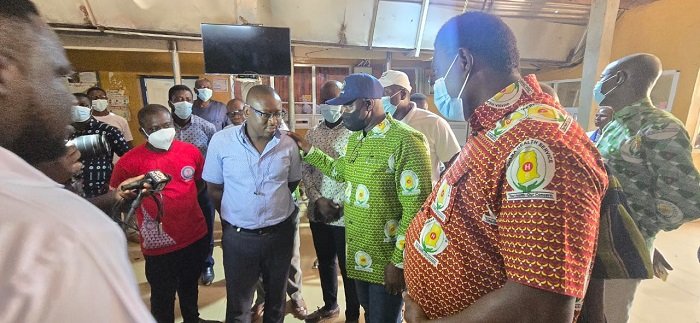
The Director General (DG) of the Ghana Health Service (GHS), Samuel Kaba Akoriyea, has tasked the Navrongo and the Kintampo Health Research Centres to intensify research aimed at uncovering the root causes of persistent seasonal meningitis outbreaks in Ghana’s meningitis belt.
Accompanied by council members, Dr Gina Teddy and Dr Michael Kofi Amedi, Dr Akoriyea also asked the centres to propose sustainable, evidence-based solutions to halt the annual loss of lives.
The directive was given during his high-level visit to the meningitis belt to assess preparedness levels, engage stakeholders, and strengthen collaboration in the fight against the disease.
He met management and research teams of both institutions in separate engagements at the Navrongo Health Research Centre in the Upper East Region and the Kintampo Health Research Centre in the Bono East Region.
Addressing the researchers, the Director General expressed concern over the recurring outbreaks that continue to claim lives, particularly during the dry season.
“We have been having these seasonal outbreaks for some time now. We need to know what is accounting for it and how we can prevent it as a country,” he stated.
He stressed that the service required solid scientific evidence to guide interventions, policies, and resource allocation.
“We want you to come out and tell us why this seasonal pattern exists and why our people are dying. We want evidence-based findings so that we can put an end to it,” he said.
Dr Akoriyea reiterated his vision of positioning research at the forefront of healthcare delivery in Ghana.
According to him, research institutions must not operate in isolation but should actively shape public health decisions.
“Research must lead the service in service delivery. It should take the lead in ensuring that we provide evidence-based services to the populace,” he emphasised.
He added that every preventable death is a heavy burden on the service and the nation as a whole.
He continued: “Every child or person that dies is a burden to us as a service. These are lives we must protect.”
Ghana lies within Africa’s meningitis belt, where outbreaks commonly occur during the dry season, often between December and May.
Factors such as dry winds, dust, overcrowding, and limited access to timely healthcare have been associated with increased transmission, but the Director General stressed the need for locally generated evidence to clearly establish why outbreaks peak during specific months; the environmental and social drivers behind transmission; gaps in vaccination coverage and surveillance; and effective prevention strategies tailored to affected communities.
The visit also served as a platform to encourage stronger collaboration between research centres, regional health directorates, community leaders, and policymakers.
BY TIMES REPORTER
Follow Ghanaian Times WhatsApp Channel today. https://whatsapp.com/channel/0029VbAjG7g3gvWajUAEX12Q
Trusted News. Real Stories. Anytime, Anywhere.
Join our WhatsApp Channel now! https://whatsapp.com/channel/0029VbAjG7g3gvWajUAEX12Q

