


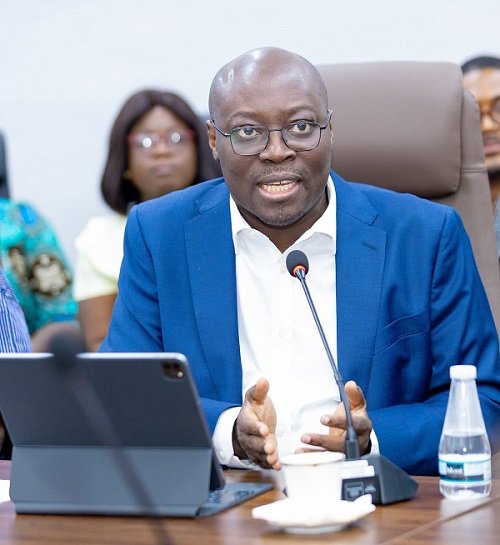
The government is at the final stages of securing Cabinet approval for a new macroeconomic policy to strengthen Ghana’s financial sector and build resilience against future economic shocks, the Minister of Finance, Dr Cassiel Ato Forson, has announced.
He said the policy was informed by lessons from the financial sector challenges of 2017 to 2019, which exposed weaknesses in governance, capitalisation, supervision and risk management and underscored the need for a stronger regulatory framework.
Dr Forson made this known in a speech delivered on his behalf at the 16th Annual General Meeting (AGM) of the Ghana Association of Savings and Loans Companies (GHALSAC) in Accra.
The AGM was held on the theme: “Building Resilience, Deepening Inclusion: Shaping Ghana’s Financial Future.”
According to Dr Forson, the reforms were not only intended to address weaknesses of the past but also to position the financial sector for sustainable growth, competitiveness and greater inclusion.
“Those challenges were difficult, but they also provided important lessons for all of us. They reminded us that sustainable growth can only be achieved on the foundations of strong governance, adequate capitalisation, effective oversight and robust risk management,” he said.
Dr Forson said a major component of the reforms was the restructuring of the microfinance sector into four categories, microfinance, community finance, credit unions and large-scale providers.
He explained that the new framework would improve institutional clarity, strengthen the sector and ensure that financial institutions were better positioned to serve the diverse needs of their respective markets.
He further indicated that the expanded mandate of ARESA First Bank to provide dedicated central banking services would enhance operational effectiveness within the sector, while the Bank of Ghana would continue to be the sole regulator and licensor.
The Minister expressed confidence that the reforms would create “a stronger, safer, more sustainable and investment-ready financial ecosystem” capable of supporting Ghana’s development aspirations.
Dr Forson said the reforms were being introduced against the backdrop of improving macroeconomic conditions, citing stronger economic growth, declining inflation, improved investor sentiment and enhanced external reserves.
“For the financial sector, macroeconomic stability is not merely an economic objective. It improves the operating environment for institutions, enhances credit quality, supports deposit mobilisation, reduces uncertainty and creates conditions for sustainable lending and investment,” he said.
Dr Forson the role of savings and loans companies in extending financial services to people and businesses that might not meet the traditional requirements of commercial banks.
He said the institutions were helping to provide finance to farmers, traders, artisans, women-owned businesses, young entrepreneurs and micro, small and medium-sized enterprises (MSMEs).
Ghana’s financial inclusion rate, he noted, had risen to 81 per cent, reflecting the impact of policy interventions, regulatory reforms, digital innovation and the expansion of financial services.
Digital inclusion
The Minister urged financial institutions to embrace digitalisation but cautioned that innovation must go hand-in-hand with cybersecurity, data protection and operational resilience.
“Our objective should not simply be digitisation, but inclusive digitisation that ensures every Ghanaian, regardless of location or income level, can participate safely in a modern financial system,” he said.
Dr Forson commended GHASLAC for its leadership and called for stronger collaboration among government, regulators, financial institutions and development partners.
He said the resilience of Ghana’s financial sector was inseparable from that of the wider economy.
GHASLAC backs reforms
The Chief Executive Officer of GHASLAC, Tweneboah Kodua Boakye, said operators in the microfinance sector supported the reforms being introduced by the Bank of Ghana.
“We are not against the reforms. We believe they will help build a strong and vibrant microfinance sector,” he said.
Mr Boakye said the sector remained a crucial component of the economy, particularly in providing jobs, supporting businesses and deepening financial inclusion.
He urged stakeholders to work together to ensure that the reforms strengthened the sector while enabling savings and loans companies to continue serving underserved communities.
BY KINGSLEY ASARE
You can now read the *Ghanaian Times* and *The Spectator* newspapers digitally on [TimesNewsPlus](https://timesnewsplus.com/newspapers).
Follow our WhatsApp Channel now! https://whatsapp.com/channel/0029VbAjG7g3gvWajUAEX12Q

