


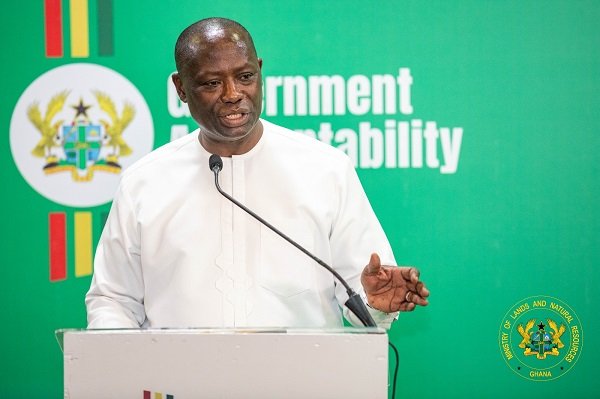
The government has officially revoked the controversial executive orders that sought to rezone the Achimota Forest.
The Minister of Lands and Natural Resources, Mr Emmanuel Armah-Kofi Buah, announced the decision at a government accountability briefing yesterday, stating that the move restores the forest’s original status as a protected reserve.
He explained that the decision also cancels the amended Executive Instrument (E.I. 234), thereby securing the forest as a vital green belt and ecological safety zone for Accra.
The development has brought relief to environmentalists who have long campaigned to preserve the capital’s primary forest cover.
Mr Buah stated that the government would no longer allow the country’s natural resources to benefit only a few individuals, adding that they would instead be managed for the prosperity of all citizens.
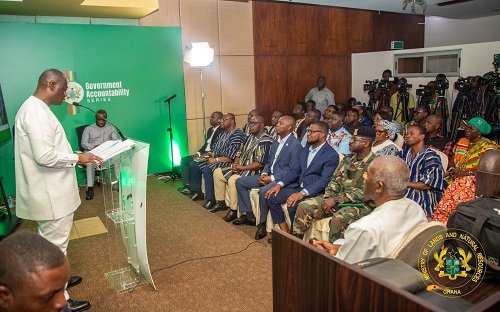
On forest restoration, the minister said progress was being made under the Tree for Life programme launched by President John Dramani Mahama.
He indicated that about 31 million seedlings were planted last year, leading to the restoration of approximately 23,600 hectares of degraded land.
He added that the target for this year remained 30 million seedlings, with planting activities already underway since June.
Mr Buah further disclosed that nearly 2,720 Youth Forest Champions had been deployed nationwide to raise seedlings, plant trees, prevent bushfires and protect forest reserves.
He said enforcement efforts within forest reserves had been intensified, with authorities seizing or disabling six excavators, more than 1,200 pumping machines, 765 changfang machines and 212 motorbikes.
He added that 430 illegal structures had been destroyed, while 258 suspects had been arrested.
Touching on the fight against illegal mining, popularly known as galamsey, Mr Buah said the National Anti-Illegal Mining Operations Secretariat carried out 200 operations in 53 districts between January and June this year, achieving an 84.1 per cent success rate.
He said the operations led to the arrest of 207 suspects, comprising 161 Ghanaians and 46 foreigners.
The minister stated that security personnel seized 78 excavators and immobilised 90 others at mining sites. In addition, nearly 2,800 changfang processing machines along river bodies were destroyed, while more than 1,000 illegal mining camp structures were pulled down.
He said security officers also recovered 112 pump-action guns, two pistols, two locally manufactured rifles and over 1,600 rounds of ammunition during the operations.
Mr Buah explained that the weapons had been handed over to the Ministry of the Interior for destruction, while seized water pumps had been transferred to the Ministry of Food and Agriculture for irrigation purposes.
According to him, Ghana has not recorded any environmental “red zone” since December 2025, explaining that such zones refer to areas severely degraded by illegal mining activities.
On mining sector reforms, Mr Buah said new royalty regulations under Legislative Instrument 2517 had been passed to enable the state to earn more revenue during periods of high mineral prices, while easing the burden on mining companies during downturns.
He added that Cabinet had approved a revised national mining policy, as well as amendments to the Minerals and Mining Act, 2006.
The proposed changes, he explained, would establish district mining committees, introduce a medium-scale mining category, limit exploration licences to five years and mining leases to 20 years, and require mining companies to sign community development agreements before being granted leases.
Mr Buah stressed that the government would pursue all individuals, financiers and criminal networks involved in environmental destruction.
He, therefore, called on traditional authorities, security agencies and local communities to support efforts to protect the country’s forests and water bodies.
BY AGNES OPOKU SARPONG
Follow our WhatsApp Channel now! https://whatsapp.com/channel/0029VbAjG7g3gvWajUAEX12Q

