


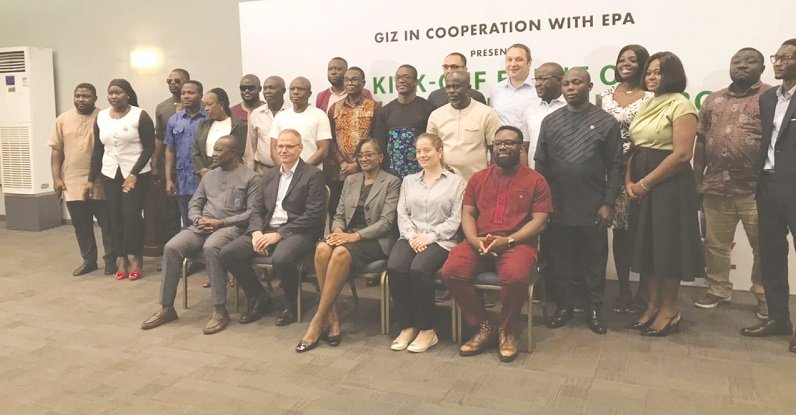
The Green Cooling Programme, aimed at transforming the country’s air conditioning sector to become climate and environmentally friendly, energy efficient, and sustainable, was yesterday launched in Accra.
It is an initiative of the Environmental Protection Agency (EPA), in collaboration with the Deutsche Gesellschaft fur Internationale Zusammenarbeit (GIZ).
The programme also seeks to reduce greenhouse gas emissions through the promotion of the adoption of green split air conditioners (ACs) that made use of the climate and environmentally-friendly natural refrigerant (R290) and consumed less energy than conventional units.
It is being funded by Switzerland based Klik Foundation under Article 6.2 of the Paris agreement and implemented by the EPA and GIZ.
Speaking at the event, the Chief Executive Officer (CEO) of the EPA, Professor Nana Ama Browne Klutse, said that the
Green Cooling Programme was important as the split AC sub-sector accounted for eight per cent of the country’s greenhouse gas emission.
“The clearance on our air conditioning unit is set to rise share. However, this growing demand comes with a significant environmental cost. The air conditioning sector is a substantial contributor to Ghana’s current and future greenhouse emissions, primarily through the leak of high global warming potentials, refrigerants, and the considerable electricity consumption of these units”, Prof. Klutse explained.
“This transition presents a monumental opportunity to significantly reduce our emissions and prevent the lock-in of harmful environmental impacts for decades to come”, She added.
According to her, the Green Cooling Programme was designed to offer financial incentives for up to 150,000 green ACs, capacity training, including comprehensive training and certification programmes for AC technicians and an end-life-management for old ACs.
Prof. Kluste also projected a 778,480 tonnes in carbon dioxide, equivalent emissions reduction under the Green Cooling Programme by the end of 2030 and, therefore urged all relevant key stakeholders to work in achieving that goal.
For her part, the Cordinator of Sustainable Energy and Climate Cluster, GIZ, Mr Gunnar Wegner, in his statement indicated that the Green Cooling Programme formed part of the various programmes and projects that it had funded to help create awareness on the mitigation potential that was associated with environmentally and climate -friendly coming technologies over the last decade.
He, therefore, urged participants to view the Green Cooling Programme as “a starting point for even greater achievements. 150,000 is a lot, but maybe we can do a million, or 10 million.
“So together, let us push the boundaries of innovation, strengthen the systems that enable change, and unite our efforts to create a cleaner, cleaner, and more prosperous Ghana.”
The Executive Secretary of the Energy Commission ((EC), Mrs Eunice A. Biritwum, noted that her outfit fully endorsed the split air conditioners transition in the country as it was a critical partner in facilitating such a transition.
She said that through its minimum energy performance standards and energy labelling regulations, the Commission had established clear criteria to limit the entry of inefficient and environmentally damaging appliances onto the Ghanaian market.
Additionally, she noted that the Commission was enhancing the technical fundamentals of the country’s energy sector through the facilitation of training on green public procurement of cooling equipment for the public entities with the Public Procurement Authority.
BY BENJAMIN ARCTON-TETTEY