


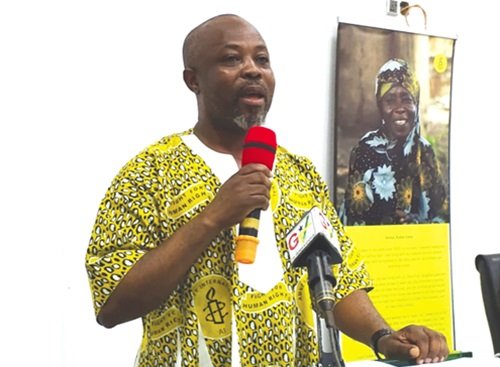
Amnesty International (AI) Ghana has appealed to President John Dramani Mahama to exercise his prerogative of mercy by granting pardons to all prisoners currently on death row.
The organisation said the continued incarceration of condemned inmates was inconsistent with Ghana’s recent abolition of the death penalty under the amended Section 149 of the Criminal Offences Act, 1960 (Act 29).
According to AI Ghana, about 91 prisoners remain on death row despite the country’s landmark legal reforms.
Speaking at the launch of Amnesty International’s 2025 Global Death Sentences and Executions Report, the Board Chair of AI Ghana, Mr Francis Nyantekyi, described capital punishment as the most cruel, inhuman and degrading treatment that could be inflicted on any human being.
He reiterated that Amnesty International opposed the death penalty in its entirety, explaining that once a person is executed, no new evidence, apology or justice system could reverse the punishment.
Mr Nyantekyi argued that the death penalty had consistently failed as a deterrent to crime, citing countries such as the United States and Iran, where executions continue despite persistent criminal activities. He revealed that Iran alone accounted for nearly 80 per cent of all recorded executions globally this year.
He further expressed concern that the death penalty disproportionately affects the poor, vulnerable and marginalised, noting that many individuals sentenced to death come from low-income backgrounds and are unable to afford quality legal representation, thereby increasing the risk of miscarriages of justice.
He therefore called for a justice system anchored on fairness, dignity and equal access to legal protection.
Mr Nyantekyi said the appeal came at a critical stage in Ghana’s justice reform process, stressing that the abolition of the death penalty must be matched with decisive steps to address all remaining death row cases.
He added that granting pardons to the condemned prisoners would align Ghana’s legal framework with its human rights commitments and mark a significant step towards a more humane justice system.
For her part, the Vice Board Chair of AI Ghana, Mrs Charity Batuure, said the report went beyond statistics, providing a comprehensive overview of global trends in executions and death sentences over the past year.
She explained that the report was ultimately about people, justice systems, human dignity and the irreversible consequences of state-sanctioned executions.
Mrs Batuure noted that behind every figure was a human story, with families devastated and individuals living for years in fear and uncertainty while awaiting resolution.
She recalled instances where vulnerable defendants lacked timely access to competent legal counsel, stressing that such situations raised not only legal concerns but also moral questions about how society values life and justice.
She maintained that the death penalty remained the ultimate cruel, inhuman and degrading punishment, which denied the right to life and had no proven deterrent effect on crime.
She also pointed out that, globally, its application continued to disproportionately affect marginalised groups, including political opponents, dissidents and environmental activists, many of whom lacked access to fair legal representation.
Mrs Batuure noted that an increasing number of countries were moving away from executions, recognising that justice could not be achieved through taking life.
She said the global movement towards abolition continued to gain momentum, driven by activists, civil society organisations, policymakers and ordinary citizens who uphold the value of human life.
She explained that the objective of releasing the report was to stimulate public and policy momentum towards abolition, expressing hope that the findings would spark meaningful debate and influence reform efforts.
According to her, lawmakers were now more open to reform than in the past, adding that decisive, evidence-based action could transform the current de facto moratorium into concrete legal and policy changes.
She said the organisation would continue to present key findings of the report, examine regional developments and engage stakeholders on steps required to advance human rights and completely abolish the death penalty.
BY CLIFF EKUFUL
Follow our WhatsApp Channel now! https://whatsapp.com/channel/0029VbAjG7g3gvWajUAEX12Q

