


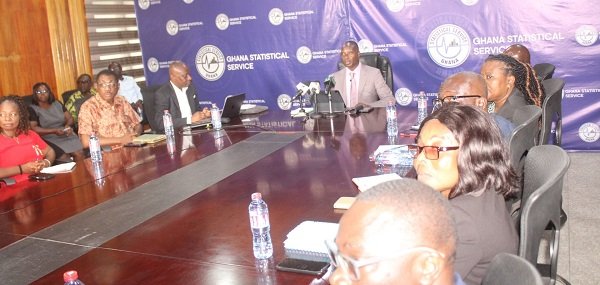
The Ghana Statistical Service (GSS) has completed the country’s first nationwide Non-Standard Units Survey (INSUS) to standardise the measurement of locally traded food items.
Conducted in collaboration with the Ministry of Food and Agriculture (MoFA), the survey covered markets, households and farm gates nationwide to determine the standard weights of food items commonly traded in local units such as olonka, bowls, bundles, buckets, crates and sacks.
Presenting the findings in Accra yesterday, the Government Statistician, Dr Iddrisu Alhassan, said the survey addressed long-standing inconsistencies arising from the widespread use of non-standard measurements in food transactions.
“Every day food changes hands not in kilograms or litres but in bowls, bundles, heaps and buckets. These measures serve Ghanaians well, but they also carry a hidden cost because the same unit can represent different weights in different parts of the country,” he said.
Dr Alhassan explained that the survey was the first of its kind in Ghana, converting commonly used local measurement units into standard grams and kilogrammes to support evidence-based policymaking.
He said the exercise identified and weighed agricultural produce sold in local units, established reliable national conversion factors, and would make the results available on an open web-based platform, alongside a photographic library of the various measurement units for future statistical work.
According to him, the initiative would improve the quality of agricultural statistics, strengthen the Consumer Price Index (CPI), reduce bias in data collection and better reflect the way Ghanaians buy and consume food.
Clarifying the distinction between INSUS and the CPI, Dr Alhassan said while the new survey measured the quantity represented by local units, the CPI focused on the prices of goods.
“The INSUS asks how much a local unit weighs, while the CPI asks how much a kilogramme of that commodity costs. They are complementary and not competing exercises,” he stressed.
He said the survey sampled 261 markets from a national frame of 1,419, in addition to about 2,000 households and selected farmers across all crop-growing areas.
To improve consistency, field officers used standard reference objects, including a 300-millilitre Coca-Cola bottle and a Bic pen, to classify the sizes of local containers before calculating average conversion factors.
The findings, he said, revealed significant regional variations in the weight represented by many local units.
Nationally, one olonka of dried white maize was found to weigh an average of 2.55 kilogrammes, while cabbage heads ranged from 0.42 kilogramme for small sizes to 1.2 kilogrammes for large ones.
Bundles of kontomire also varied considerably, whereas bottled palm oil recorded relatively consistent weights across the country.
Dr Alhassan added that similar variations were observed at household and farm-gate levels, particularly for commodities measured in cups, buckets and other containers, underscoring the need for standard conversion factors.
He said the survey had provided Ghana with its first nationally representative database on non-standard food measurement units, which would enhance food price statistics, agricultural production estimates and household consumption data.
Dr Alhassan urged government institutions, researchers and development partners to adopt the new conversion factors to improve the reliability and comparability of national statistics.
BY KINGSLEY ASARE
Follow our WhatsApp Channel now! https://whatsapp.com/channel/0029VbAjG7g3gvWajUAEX12Q

