


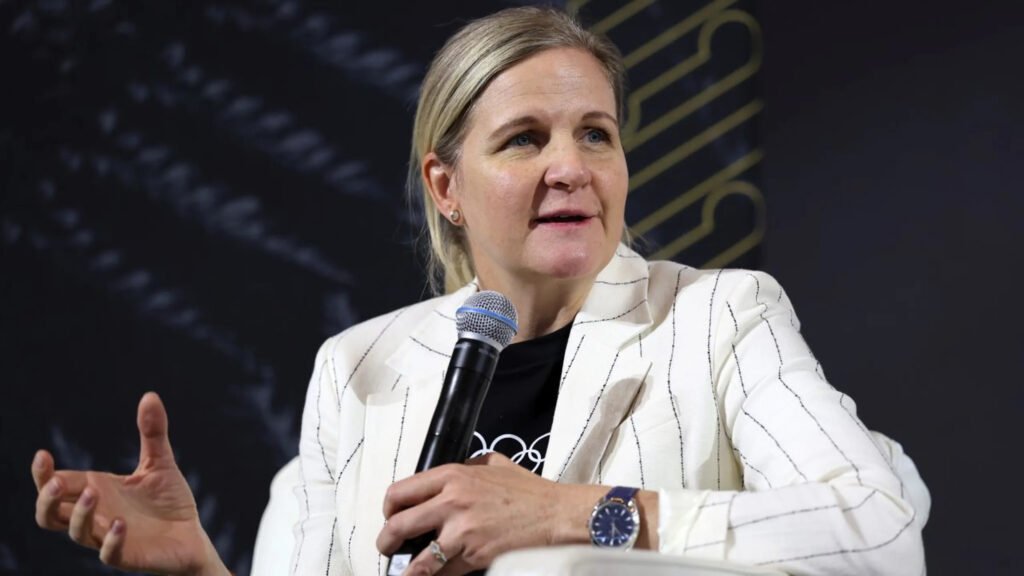
The president of the International Olympic Committee recently argued in remarks reported by the outlet Sport Nation that the Games must uphold their solidarity model and not introduce direct payments for participating or winning.
The Zimbabwean official thus placed one of the Olympic movement’s most sensitive debates at the center of her first stage at the head of the organisation, at a time when the IOC is reviewing how the Games should evolve under the ‘Fit For the Future’ approach.
“I don’t believe in paying athletes”, Kirsty Coventry told the New Zealand outlet, also linking her position to her own experience as an athlete from a small country and from a sport without major salary structures. “I come from a small country, I came from a sport that doesn’t necessarily pay athletes very well and I still don’t think we should be paying athletes at the Olympic Games,” she added.
Coventry’s argument did not deny the financial difficulties faced by many Olympic athletes, but shifted the response onto different terrain. According to Sport Nation, the new head of the IOC said the organisation must “find more ways to directly impact athletes and find ways to help them on their journey to becoming Olympians and while they’re Olympians”, with measures linked to talent identification, scholarships, preparation and professional transition.
The president drew on a personal reference. “I was an Olympic solidarity scholarship holder without that money. I’m not sure I would have been as successful, and so I’m so grateful for that,” Coventry said as she defended a system that prioritises support channeled through national Olympic committees and Olympic Solidarity programmes rather than direct payments for participation or results.
The IOC’s official model is based on redistributing its revenue to the Olympic movement, organising committees, federations, national committees and development programmes. The organisation itself says it distributes 90 per cent of its revenue to support athletes and sports organisations around the world, while Olympic Solidarity is defined as a mechanism that helps national Olympic committees with athlete development programmes.
The debate, however, has intensified since World Athletics broke a historic barrier by announcing prize money for Olympic athletics champions at Paris 2024, with $50,000 (€43,000) for each individual gold and the same amount to be shared among relay teams, subject to the ratification of the result and anti-doping checks.
A similar discussion is also unfolding in tennis, where French Open Director Amélie Mauresmo has ruled out changing Roland Garros prize-money standards this year despite pressure from leading players, who argue that they receive only 14.3 per cent of the tournament’s revenue and want that share raised to 22 per cent. The Grand Slam has confirmed a 9.5 per cent increase in total prize money to €61.7 million, including €2.8 million for each singles champion, while the French Tennis Federation defends its model by pointing to grassroots investment, operating costs and the indirect commercial value the event generates for players.
Against that trend, Coventry argued that resources are already transformed into services, infrastructure and a competitive experience. “Well, they get beautiful venues. They get beautiful villages. They get a beautiful experience. And all of that comes from the money that we raise,” she told Sport Nation during the part of the conversation devoted to criticism over the use of athletes’ name, image and likeness without direct financial compensation.
The president also rejected transferring to Olympism a model similar to that of the United States’ National Collegiate Athletic Association, which since 2021 has allowed college athletes to benefit from commercial deals linked to their profile. In her view, accepting a more direct payment logic could alter the distribution of resources within the movement and affect the breadth of countries, sports and participants that characterises the Games.
“So again, what I challenge athletes, international federations that are always asking for more money, national Olympic committees, the solidarity model is very particular,” Coventry said, before warning that a profound transformation would have structural consequences. “Now, if the entire movement wants us to change, we would have not as many countries, we’d have not many sports, we’d be very particular on what that would look like. I don’t think that’s the Olympic Games and I don’t think the Olympic movement thinks that’s the Olympic Games.”
Coventry accepts that the IOC must improve its support for athletes, but not through direct payments for participating or winning at the Games. Her position, at least for now, is to preserve the solidarity model and strengthen channels of assistance in a sporting ecosystem where the debate over compensation and the commercial value of athletes is gaining weight.-insidethegames
Follow our WhatsApp Channel now! https://whatsapp.com/channel/0029VbAjG7g3gvWajUAEX12Q

