


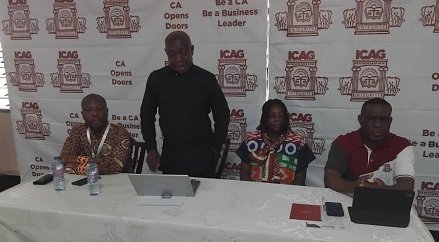
A five-day national conference of the Institute of Chartered Accountants Ghana (ICAG) has opened in Ho, with a strong focus on repositioning the accountancy profession to respond to rapid global changes and emerging challenges.
The conference, which has drawn about 2,000 participants, is on the theme: ‘Building Strong and Sustainable Economies: Standards, Integrity, and Accountability.’
Briefing journalists ahead of the official opening on Monday, the President of ICAG, Augustine Addo, said the institute was implementing a five-year strategic development plan aimed at strengthening regulation and enforcing ethical standards within the profession.
He explained that the plan was aligned with the Sustainable Development Goals (SDGs) and designed to respond to shifts in the global economic landscape.
Mr Addo indicated that the strategy would focus on strengthening the institute’s regulatory authority, deepening ethical compliance, modernising professional education and accelerating digital transformation.
He added that the institute was also preparing its members to adapt to future demands in an evolving profession.
As part of these efforts, he indicated that ICAG was pursuing amendments to the Institute of Chartered Accountants, Ghana Act, 2020 (Act 1058) to ensure that the legal and regulatory framework remained relevant, particularly in areas such as ethics, sustainability and audit quality management.
Mr Addo noted that the accountancy profession was undergoing significant transformation, driven largely by the rise of Artificial Intelligence (AI), growing demand for sustainability reporting and increasing public scrutiny of institutions.
He observed that public confidence in organisations was now closely tied to transparency and ethical leadership.
Touching on Ghana’s standing in the profession, Mr Addo stated that the country was gaining recognition on the African continent for its quality assurance systems.
According to him, through the work of the Accountancy Practice Review Committee (APRC), Ghana had developed a monitoring framework that had become a model for other countries.
He said professional bodies and regulators from countries such as Nigeria, Sierra Leone, Lesotho and Namibia had visited Ghana to learn from its best practices.
“At a time when financial scandals continue to shake public confidence globally, Ghana is emerging as a reference point for strengthening audit quality and professional oversight in Africa,” he stressed.
Mr Addo further indicated that ICAG would expand its digital transformation drive, including the introduction of full online examinations and the deployment of AI-powered customer service systems.
He added that the institute would also strengthen sustainability and climate reporting competencies, enhance whistleblower protection mechanisms and play a more active role in national discussions on public financial management and governance.
The Chief Executive Officer of ICAG, Eric Oduro Osae, emphasised that strong and sustainable economies depended on credible and transparent financial systems.
He said such systems must be well-governed and capable of scrutiny, adding that sustainability required that present growth not to compromise the future.
Mr Osae noted that the conference would challenge participants to rethink how sustainability could be embedded into business strategies, without undermining social equity and long-term value creation.
FROM SAMUEL AGBEWODE, HO
Follow our WhatsApp Channel now! https://whatsapp.com/channel/0029VbAjG7g3gvWajUAEX12Q

