


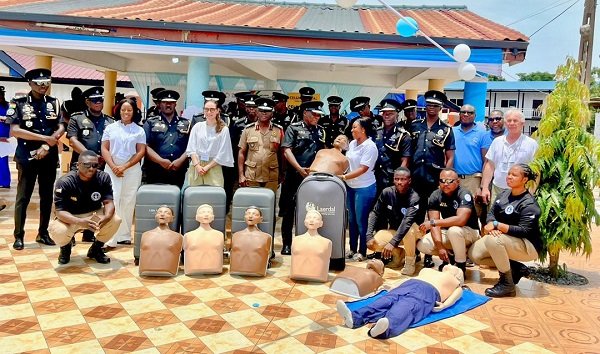
THE Inspector General of Police (IGP), Christian Tetteh Yohuno, has called for the expansion of emergency medical response training to all personnel of the Ghana Police Service, stressing that lifesaving skills were now essential to modern policing.
He said police officers were often the first to arrive at accident scenes and other emergencies, and must, therefore, be equipped with the knowledge and tools to preserve life before victims were conveyed to health facilities.
The IGP made the call at the closing ceremony of a two-day Train-the-Trainer programme on emergency medical response for the National Formed Police Unit, organised in collaboration with Global Lifesavers Inc., the Ghana National Ambulance Service, and the European Resuscitation Council yesterday.
He said the police administration was committed to extending the training across all units, while also ensuring the provision of logistics and equipment to support effective emergency response in the field.
“This is how we build a modern police service, one that is professional, responsive, and deeply committed to the safety and well-being of both our officers and the citizens we serve,” he explained.
The IGP urged participants, who had undergone the training, to serve as ambassadors of the programme by transferring knowledge and skills to other officers across the country.
The president of Global Lifesavers Inc., Dr Selina Okyere, in her goodwill message, said the initiative was aimed at equipping officers with critical skills in Cardiopulmonary Resuscitation (CPR), First Aid, and tactical emergency care.
She said the programme went beyond training and focused on building the capacity of officers to respond effectively during emergencies, both in the line of duty and within communities.
Dr Okyere expressed appreciation to the police administration for the partnership, noting that it would significantly strengthen emergency response systems and improve public safety outcomes.
Also speaking, a representative of the European Resuscitation Council, Mazarine Tyssens, underscored the importance of early intervention in cases of cardiac arrest.
She noted that most cardiac arrest incidents occur outside hospital settings, and the immediate response of bystanders, particularly police officers, could determine survival outcomes.
Ms Tyssens said the initiative would empower officers with the confidence and practical skills required to act swiftly in such situations, adding that the donation of CPR training mannequins and other equipment would support continuous learning.
The programme also introduced a trainer-to-trainer model to ensure sustainability, allowing trained officers to cascade knowledge to colleagues across regions.
As part of the event, emergency response kits were presented to the police administration to support field operations.
The two-day training formed part of efforts to strengthen inter-agency collaboration and enhance Ghana’s capacity to respond to medical emergencies, particularly in critical early moments where timely intervention could save lives.
BY STEPHANIE BIRIKORANG
Follow our WhatsApp Channel now! https://whatsapp.com/channel/0029VbAjG7g3gvWajUAEX12Q

