


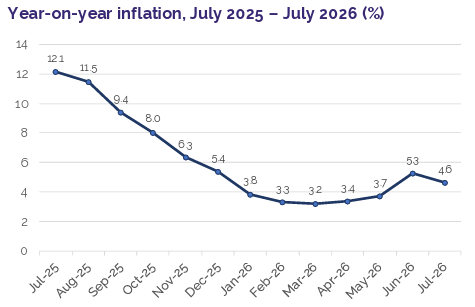
Ghana’s year-on-year inflation rate declined further to 4.6 per cent in July 2026, from 5.3 per cent in June, indicating a continued slowdown in the pace of price increases across the economy.
The latest figures released by the Ghana Statistical Service (GSS) showed that although prices continued to rise, the rate of increase was significantly lower than the 12.1 per cent recorded in July 2025.
Presenting the Consumer Price Index (CPI) for July in Accra yesterday, the Government Statistician, Dr Alhassan Iddrisu, said the 4.6 per cent inflation rate represented the change in the CPI over the 12-month period between July 2025 and July 2026.
He explained that the monthly inflation rate for July stood at 0.1 per cent, suggesting that overall price levels remained relatively stable compared with the previous month.
Dr Iddrisu said food and non-alcoholic beverages recorded an annual inflation rate of 3.1 per cent in July, down from 3.9 per cent in June.
Non-food inflation also eased marginally to 6.1 per cent from 6.3 per cent during the same period.
He, however, noted that services remained the biggest source of inflationary pressure, recording an annual inflation rate of 8.5 per cent, although this was lower than the 9.4 per cent recorded in June.
Goods inflation also slowed to 3.4 per cent from 3.7 per cent.
The Government Statistician said locally produced goods and services continued to account for the larger share of inflation, recording 5.9 per cent compared with 2.0 per cent for imported items.
He attributed the trend to domestic production costs, including transport, energy and wages.
“Imported inflation remains relatively low, suggesting that exchange rate stability is helping to contain the cost of foreign goods,” he said.
Dr Iddrisu observed that inflation had returned to its downward trajectory after recording slight increases between March and June this year.
He noted that July’s rate was close to the year’s lowest inflation figure of 3.2 per cent recorded in March.
The report showed variations in inflation rates across the regions. The North East Region recorded the highest inflation rate at 10.8 per cent, while Bono East Region recorded a negative inflation rate of 3.8 per cent, making it the only region where prices declined over the period.
Six regions recorded inflation rates above the national average.
The GSS data further showed that food and beverages contributed 32.4 per cent of total inflation, while non-food items accounted for the remaining 67.6 per cent.
At the commodity level, ginger recorded the highest annual price increase of 111.3 per cent, while the price of kontomire declined significantly by 41.2 per cent.
Dr Iddrisu said the continued decline in inflation provided households and businesses with greater certainty for planning.
He, however, urged policymakers to maintain prudent fiscal measures and strengthen supply-side interventions to sustain the gains and keep inflation on a downward path.
BY KINGSLEY ASARE
Follow our WhatsApp Channel now! https://whatsapp.com/channel/0029VbAjG7g3gvWajUAEX12Q

