


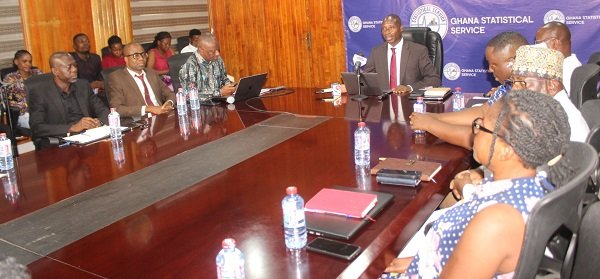
New data collected by the Ghana Statistical Service (GSS) on the building and construction sector has revealed that the cost of building a house in the country is decreasing. Called the Prime Building Cost Index (PBCI), the new indicator shows that inflation for the building sector eased sharply to 9.7 per cent in September 2025 from 18.4 per cent in September 2024.
The Government Statistician, Dr Alhassan Iddrisu, who released the maiden PBCI data on Friday, said the index tracks changes in the overall cost of constructing buildings, focusing on three key inputs, namely materials, labour, and plant and equipment. BY KINGSLEY ASARE
He noted that the September year-on-year inflation of 9.7 per cent marked the fifth consecutive decline in building inflation, falling from 22.6 per cent in December 2024 to 12.0 per cent in August 2025, and further to 9.7 per cent in September. Month-on-month inflation stood at -0.4 per cent, indicating a decline in overall building costs between August and September.
“The continuous month-on-month price declines show that price pressures in the construction environment are cooling in real time,” he said.
Dr Iddrisu also mentioned that labour inflation fell marginally from 15.7 per cent in August to 15.1 per cent in September, contributing about 30 per cent to overall building inflation. On a month-on-month basis, labour costs increased slightly by 0.1 per cent, reflecting the relatively slow adjustment of wages and service charges in the construction sector.
Materials inflation, he noted, fell significantly from 11.1 per cent in August to 8.4 per cent in September. Materials accounted for 67 per cent of the overall inflation rate and recorded a month-on-month decline of 0.5 per cent. “Materials make up the largest portion of most construction budgets, so when their prices cool, the entire sector benefits,” he stated, adding that easing material prices had been the main driver of declining building inflation since June.
Additionally, Dr Iddrisu disclosed that plant inflation also slowed from 10.8 per cent in August to 8.2 per cent in September, with plant costs decreasing by 1 per cent month-on-month. Plant inputs contributed 3.1 per cent to overall building inflation but recorded the steepest price fall between August and September.
On the subgroup performance, he said steel recorded the highest inflation at 19 per cent, while reinforcement registered the lowest inflation at -4.9 per cent.
Dr Iddrisu further noted that inflation within the construction sector was highly concentrated, with the top 10 subgroups, including skilled and unskilled labour, tiles, glazing, and electricals, accounting for 97.4 per cent of total inflation.
He said the compilation of data on the PBCI was crucial, saying the construction sector touched almost every aspect of national life—from homes and schools to clinics, hostels, factories and government offices—and influenced contractors, developers, architects, artisans and public budgeting.
Offering some recommendations, Dr Iddrisu encouraged households to resume building projects while prices remain stable, build in phases, and replace costly imports with quality local materials. He then advised businesses to secure medium-term contracts and revise bids to reflect lower costs.
To Government, he recommended channelling incentives into local material production, fast-tracking infrastructure projects, and using PBCI data to guide transparent procurement processes while prices remain stable.
🔗 Follow Ghanaian Times WhatsApp Channel today. https://whatsapp.com/channel/0029VbAjG7g3gvWajUAEX12Q
🌍 Trusted News. Real Stories. Anytime, Anywhere.
✅ Join our WhatsApp Channel now! https://whatsapp.com/channel/0029VbAjG7g3gvWajUAEX12Q

