


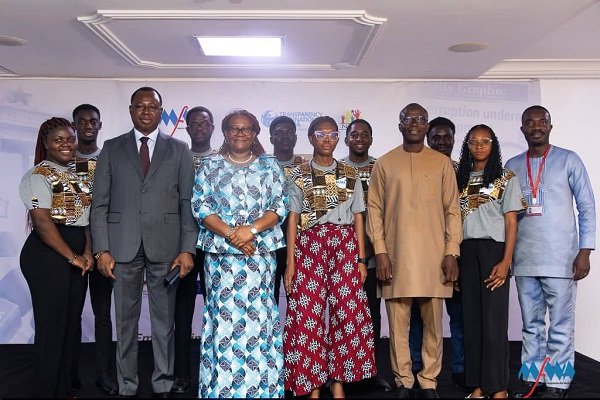
Panellists at a public forum on corruption have warned that Ghana’s fight against the canker would remain ineffective unless citizens, civil society organisations and state institutions commit to integrity, accountability and the impartial enforcement of the law.
They said selective justice and weak public confidence in accountability institutions remained major obstacles to combating corruption and called on the media to play a more active role in holding public officials accountable by following corruption cases through to the latter to nip it in the bud.
The panellists were the Chairperson of Crusaders Against Corruption, Bishop Dr Suzanne Nti, the Fundraising Manager of Transparency International Ghana, Mr Michael Boadi, and Investigative Journalist, Mr Manasseh Azure Awuni.
On the theme: ‘Restoring Citizens’ Trust in the Fight Against Corruption in Ghana: The Role of the Media,’ the public forum organised by the Media Foundation for West Africa (MFWA) brought together anti-corruption advocates, media practitioners, civil society organisations, governance experts and members of the public to explore practical ways of strengthening trust in Ghana’s accountability institutions.
Bishop Nti said many Ghanaians had become sceptical because corruption stories which often dominated news headlines disappeared before the public saw their outcomes.
“Citizens are no longer impressed by the arrests, press conferences, investigations or accusations.
Trust is restored when the public sees convictions, recovered assets, sanctions and accountability. The media must follow the story from allegation to conclusion,” she said.
Bishop Nti stressed the need to build strong family values, arguing that individuals who engage in corrupt practices in public office are often products of society.
“We have a crisis of integrity in Ghana, and we need to build strong families because these are the same people who will sit in offices where corruption happens,” she noted.
Mr Boadi expressed concern about the growing tendency of Ghanaians to view accountability institutions through partisan lenses.
According to him, public trust in institutions such as the judiciary and the police often depended on which political party was in power, making it difficult to build confidence in the country’s anti-corruption fight.
For his part, Mr Azure called for greater citizen participation, stronger institutions and sustained oversight of anti-corruption bodies to strengthen the fight against corruption.
He stressed that while anti-corruption institutions must be allowed to perform their functions independently, they must also be held accountable to ensure they remain effective and responsive to the public interest.
BY ABIGAIL ANNOH
Follow our WhatsApp Channel now! https://whatsapp.com/channel/0029VbAjG7g3gvWajUAEX12Q

