


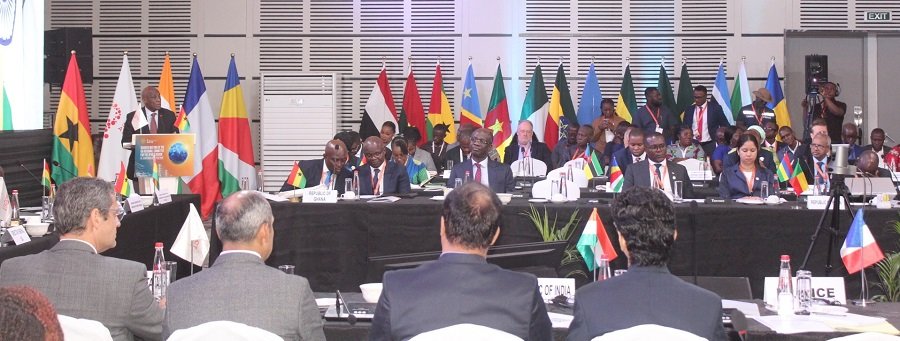
The President, John Dramani Mahama, has called for stronger collaboration among African countries to harness the continent’s vast solar resources to accelerate development and guarantee energy security.
He said despite Africa possessing 60 per cent of the world’s best solar resources, it accounts for only three per cent of global solar photovoltaic (PV) capacity.
“This imbalance must change. Africa needs about $90 to $100 billion annually to achieve universal energy access by 2030, yet we attract less than three per cent of global clean energy investments,” the President said in a speech read on his behalf by the Presidential Advisor on the Economy, Mr Seth Terkper, at the opening of the Seventh Meeting of the International Solar Alliance (ISA) Regional Committee for Africa in Accra yesterday.
The three-day conference, on the theme “Catalysing Solar Investments and Institutional Capacity across the Continent,” is expected to explore financing, technology and policy interventions to scale up solar adoption.
It would consider catalytic financing, capacity building, digitalisation, and technology policies to accelerate solar deployment across the continent.
As part of the programme, Ghana, The Gambia and Nigeria signed a pact to collaborate on solar energy development.
President Mahama said the cost of solar PV had fallen by 85 per cent in the last decade, making it the cheapest source of electricity in many regions.
“In 2024, global investment in solar reached a record $521 billion. Africa received about $40 billion, up from $2.6 billion in 2021, but this is still woefully inadequate given the scale of our needs,” he stated.
He stressed that concessional financing and innovative domestic funding mechanisms were critical.
The Minister of Energy and Green Transition, Mr John Jinapor, said Africa had a dual responsibility to acknowledge progress while addressing challenges.
“Too often, we dwell on what is not working. By the end of 2024, Africa’s installed solar capacity had reached 14.3 gigawatts, with South Africa, Egypt, Morocco, Tunisia, Algeria, Kenya and Ghana emerging as leaders,” he said.
Mr Jinapor said Ghana currently had 200 megawatts of installed solar PV capacity, with another 400 megawatts expected by 2026. He noted that government had launched a $3.4 billion five-year renewable energy action plan to add 1,400 megawatts of new capacity by 2030, alongside initiatives such as installing 100,000 solar streetlights, 2,500 water pumping units for smallholder farmers, and 400 mini-grids for island communities.
“We require about $50 billion annually to meet Africa’s energy needs but currently mobilise only $10 billion. Clearly, private sector investment is indispensable if we are to bridge the gap,” he said.
The Director-General of ISA, Mr Ashish Khanna, emphasised the urgency of moving from ambition to action.
“Energy is a human right. Less than two per cent of global clean energy investment reaches Africa. That is not acceptable. Implementation partnerships, innovation in financial structures and strengthening research institutions are the only way out of energy poverty,” he said.
BY KINGSLEY ASARE