


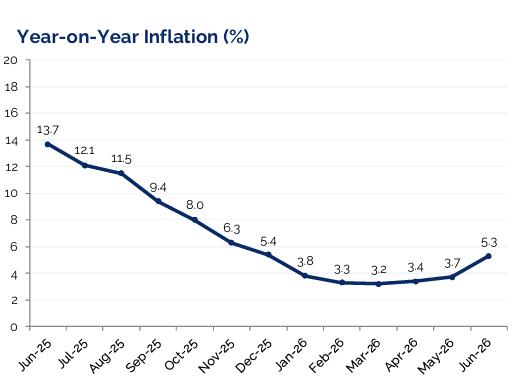
The country’s year-on-year inflation rate rose to 5.3 per cent in June 2026 from 3.7 per cent in May, marking the third consecutive monthly increase, the Ghana Statistical Service (GSS), has announced.
The GSS noted that year-on-year inflation had declined steadily from 13.7 per cent in June 2025 to a low of 3.2 per cent in March this year before rising gradually over the past three months to 5.3 per cent in June.
On month-on-month, it said consumer prices increased by 0.2 per cent on a month-on-month basis in June, down from 1.1 per cent in May.
Data on June 2026 inflation figures released by the GSS on Thursday and copied to The Ghanaian Times, said the CPI increased to 270.8 in June 2026 from 257.3 recorded in June 2025.
It said non-food inflation remained the largest contributor to headline inflation, accounting for 68.5 per cent of the overall rate. It increased to 6.3 per cent in June from 4.1 per cent in May.
The GSS said services continued to record stronger price increases than goods, with services inflation standing at 9.4 per cent compared to 3.7 per cent for goods.
However, services inflation eased slightly from the 9.9 per cent recorded in May.
The GSS said food inflation also edged up to 3.9 per cent in June from 3.3 per cent in the previous month, contributing 31.5 per cent to headline inflation.
The report further showed that inflation was largely driven by locally produced goods, which recorded a year-on-year inflation rate of 6.7 per cent, up from 5.0 per cent in May, and accounted for 86.6 per cent of the overall inflationary pressures.
It said imported goods registered a comparatively lower inflation rate of 2.3 per cent, increasing from 0.9 per cent in May.
The GSS indicated that ginger recorded the highest annual price increase at 102.5 per cent, followed by shrimps at 90.8 per cent and mangoes at 87.2 per cent. Bananas, avocado pears, fresh coconuts, palm fruits, rakes, cashew and dried fish (koobi) also registered notable price increases.
On the other hand, prices of several food items declined significantly. Kontomire recorded the largest decrease at 38.0 per cent, followed by garden eggs, maize, millet, pawpaw, beans, guinea corn, lime, imported apples and firewood.
The biggest contributors to overall inflation included bus and trotro fares, which accounted for 10.5 per cent, payment of rents (8.4 per cent), secondary school fees (7.2 per cent), ginger (7.0 per cent), river fish (6.6 per cent), cooked rice (5.3 per cent), fresh tomatoes (5.2 per cent), yam (5.1 per cent), hotel accommodation (4.0 per cent) and green plantain (3.8 per cent).
On regional inflation, the GSS said regional inflation also showed considerable variation. The North East Region recorded the highest inflation rate of 10.2 per cent, while Bono East recorded the lowest at minus 4.4 per cent.
The GSS advised households to prioritise essential spending, take advantage of seasonal foods and review household budgets regularly.
It also encouraged businesses to strengthen supplier arrangements, monitor costs closely and improve operational efficiency, while urging government to maintain prudent macroeconomic policies and address supply chain bottlenecks to sustain the gains made in inflation moderation.
BY KINGSLEY ASARE
Follow our WhatsApp Channel now! https://whatsapp.com/channel/0029VbAjG7g3gvWajUAEX12Q

