


Ghana’s mining industry is projected to record higher mineral output in 2026, with large-scale gold production expected to range between 3.2 million and 3.4 million ounces, while small-scale miners are forecast to produce between 2.9 million and 3.5 million ounces.
Manganese production is also projected to reach between 5.0 million and 6.0 million tonnes, with bauxite output expected to range from 2.5 million to 3.0 million tonnes. Diamond production is estimated at between 150,000 and 250,000 carats.
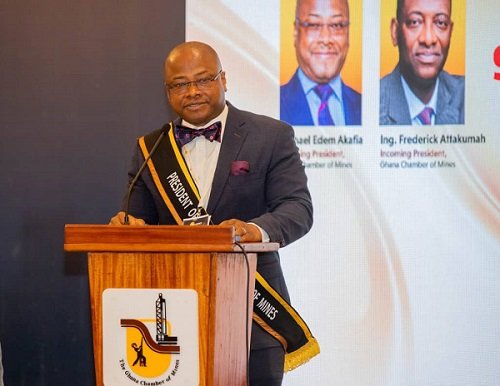
The Outgone President of the Ghana Chamber of Mines (GCM), Mr Michael Edem Akafia, disclosed this at the Chamber’s 98th Annual General Meeting held in Accra last Friday, however, the target would depend largely on policy certainty, regulatory reforms, timely renewal of mining leases, improved governance of small-scale mining and sustained investment across the minerals value chain.
Mr Akafia noted that despite economic and regulatory challenges, Ghana’s mining sector remained one of the strongest pillars of the national economy in 2025.
He said attributable gold production increased significantly from 4.82 million ounces in 2024 to 5.94 million ounces in 2025, representing a growth of 23.41 per cent.
According to him, the increase was largely driven by the small-scale mining subsector, whose output surged by 63.82 per cent to 3.11 million ounces.
For the first time in more than a century, he said small-scale mining contributed more than half of Ghana’s total gold production, accounting for 52.4 per cent of national output.
Mr Akafia explained that reforms introduced by government, including the establishment of the Ghana Gold Board, contributed to the remarkable growth recorded by the subsector.
He, however, expressed concern over the decline in large-scale gold production, which fell by nearly three per cent from 2.92 million ounces in 2024 to 2.83 million ounces in 2025.
Despite the decline, he said the mining industry continued to play a critical role in the economy, contributing substantially to government revenue, foreign exchange earnings and employment.
The mining and quarrying sector remained Ghana’s largest source of direct domestic tax revenue in 2025, contributing GH¢23.11 billion in taxes, compared to GH¢20.87 billion in 2024.
In addition, mineral export earnings rose sharply from $11.98 billion to $21.36 billion, increasing the sector’s share of total merchandise exports to more than 68 per cent.
He disclosed that producing member companies of the Chamber spent about $7.14 billion within Ghana in 2025, representing nearly 73 per cent of their realised mineral revenue.
Touching on challenges facing the industry, he cited rising operating costs, illegal mining, policy uncertainty and concerns over security of tenure as key issues requiring urgent attention.
He cautioned that recent increases in the sector’s fiscal burden, including changes to the mineral royalty regime, could affect competitiveness and discourage future investments if not carefully reviewed.
Mr Akafia called for continued collaboration between government, regulators, industry players and host communities to ensure that the country derives maximum benefit from its mineral resources.
As he handed over leadership of the Chamber, he expressed confidence that the incoming administration would continue to champion policies that promote a competitive, responsible and sustainable mining industry.
“The sector has demonstrated remarkable resilience and remains a vital driver of Ghana’s economic development,” he said.
BY KINGSLEY ASARE
Follow our WhatsApp Channel now! https://whatsapp.com/channel/0029VbAjG7g3gvWajUAEX12Q

