


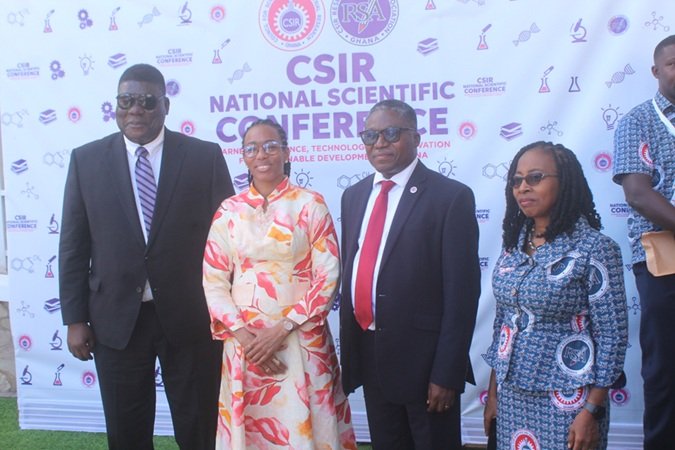
THE Minister of Environment, Science and Technology, Dr Zanetor Agyeman-Rawlings, has urged scientists at the Council for Scientific and Industrial Research (CSIR) to develop alternatives to conventional plastics ahead of the planned ban on Styrofoam products next year.
She said the ban would be only a first step towards addressing the environmental and public health risks associated with plastic waste, stressing the need for sustainable alternatives.
“If we come up with a substance that looks like plastic, behaves like plastic in that it can maintain its structure, it can hold whatever is in it. But once you have consumed what is in it, it breaks down into a harmless residue of some plant product which can then go back to nature,” she said.
“Styrofoam ban on its own will not deal with the plastic mess. It will not deal with the microplastics in our food chain,” she added.
Dr Agyeman-Rawlings was speaking at the launch of the CSIR Scientific Conference in Accra yesterday.
The conference was held on the theme: “Harnessing Science, Technology and Innovation for Sustainable Development in Ghana”.
She challenged researchers to develop plant-based materials that could perform the same functions as conventional plastics but break down into harmless residues after use.
She said Ghana needed innovative solutions that went beyond banning specific plastic products to address the wider effects of plastic pollution, including the presence of microplastics in the food chain and potential exposure to toxic chemicals.
“We need to come up with solutions. We need to be disruptive in our thinking. Let’s reinvent the wheel. Literally,” she said.
The minister also called for stronger partnerships between the CSIR and the private sector to turn scientific research into commercially viable products.
She said researchers needed support from marketing and commercialisation units to connect their innovations to industry, allowing them to focus on research while improving the financial sustainability of their work.
“The reality is your main job is science. Look around where you see the deficits, where you see the challenges, and you’re supposed to provide the solutions,” she said.
Dr Agyeman-Rawlings said collaboration with industry could also help research institutions generate additional resources to sustain their operations beyond government funding for salaries and wages.
She stressed that scientific research must inform policymaking and urged the CSIR to strengthen links among research institutions, industry and government to ensure that innovations contributed to national development.
The Chairman of the CSIR Governing Council, Ing. Mark Anthony Taylor, also called for stronger collaboration among research institutes, universities, government agencies, industry and communities to ensure scientific research addressed Ghana’s development challenges.
He highlighted the potential of artificial intelligence (AI) to improve research in areas such as agriculture, disease surveillance, water quality, climate risk and industrial development.
However, he cautioned that the adoption of AI must be supported by reliable data, research ethics, cybersecurity measures and human oversight.
BY ABIGAIL ARTHUR


SKIP THE QUEUE, TAP THE NEWS
Read the Ghanaian Times and The Spectator newspapers from the comfort of your device via TimesNewsPlus.
Follow our WhatsApp Channel now! https://whatsapp.com/channel/0029VbAjG7g3gvWajUAEX12Q

