


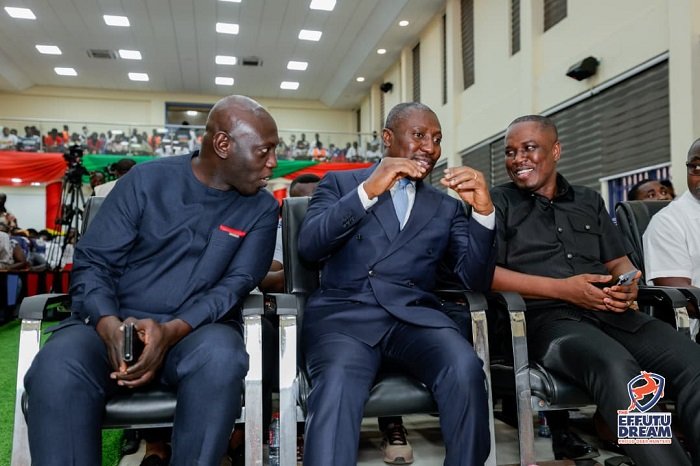
The Minority Leader in Parliament, Alexander Afenyo-Markin, has called on the government to move beyond slogans and political rhetoric, urging it to concentrate on the fundamental duties of governance: development, job creation, and upholding the rule of law.
He made the remarks while delivering the keynote address at The Young Commons Forum, UCC Summit at the University of Cape Coast. His presentation focused on the theme: “The Danquah-Busia-Dombo Centre-Right Ideology and Its Impact on Ghana’s Socio-Economic Development: A focus on the Kufuor and Akufo-Addo Governments.”
According to Mr. Afenyo-Markin, the country had experienced a year in which the government “believed more in rhetoric than results, one that talked more than it worked.”
“The government has reneged on its promises to Ghanaians, including the much-touted 24-hour economy policy. It promised a women’s bank and to raise the producer price of cocoa to GH¢6,000 per bag.”
“Today, unemployment is on the rise. The government has failed to implement its own flagship initiatives. Instead, it has created a bureaucracy for its so-called 24-hour economy. To our mind in the Minority, this 24-hour economy is more of a slogan than a policy. The women’s bank has also not seen the light of day,” he stated.
Touching on cost-of-living challenges, the Minority Leader said: “While the government speaks about lower inflation levels, ordinary Ghanaians are suffering. Electricity prices have jumped by almost 30 per cent. They came to repeal the E-levy but ended up with the so-called ‘dumsor levy’, charging GH¢1 per litre of petrol. Above all, the cocoa farmer is the real loser today.”
Mr. Afenyo-Markin emphasised that although his party did not win the majority in the Ninth Parliament, its mission remained clear: to contribute constructively on the floor of the house and enrich Ghana’s democracy.
He reflected on Ghana’s political traditions since independence, noting three main strands: the liberal-democratic Danquah-Busia–Dombo tradition, the socialist-oriented Nkrumahist tradition, and the Rawlings tradition, which emerged under the PNDC and continued into the Fourth Republic.
“While Nkrumahism emphasised state-led development and centralised authority, the Danquah–Busia–Dombo tradition promotes liberal democracy, constitutionalism, individual liberty, decentralisation, and a market-oriented economy,” he explained.
Mr. Afenyo-Markin traced the ideological roots of Ghana’s two main parties: the National Democratic Congress (NDC), which draws from Rawlings and Nkrumahist traditions, and the New Patriotic Party (NPP), which identifies with the Danquah-Busia–Dombo lineage.
He highlighted examples of centre-right governance, citing flagship projects from the Kufuor administration, including the Metro Mass Transit system (“Kufuor Bus”), cocoa sector reforms, and pension restructuring. Under the Akufo-Addo administration, he pointed to policies such as the Free Senior High School programme, expansion of Technical and Vocational Education and Training (TVET), One-District-One-Factory, Planting for Food and Jobs, and Agenda 111.
“These interventions reflect a coherent centre-right logic, where the state acts as an enabler of private enterprise rather than a substitute for it. Investments in health, education, agriculture, and industrialisation empower citizens and expand productive participation in the economy,” he underlined.
Mr. Afenyo-Markin maintained that the Danquah–Busia–Dombo tradition remains a living political philosophy, capable of adapting to contemporary challenges while staying rooted in liberty, enterprise, and constitutional governance.
BY TIMES REPORTER
Join our WhatsApp Channel now! https://whatsapp.com/channel/0029VbAjG7g3gvWajUAEX12Q


Follow the latest videos and updates on the official YouTube channel of Ghanaian Times.