


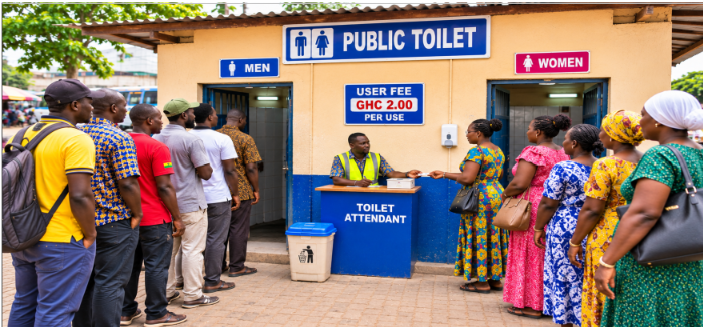
The real measure of a decent home is not simply the roof over its occupants’ heads, but whether the household can meet its basic needs safely, privately and with dignity. Ghana’s sanitation challenge therefore requires more than building additional public toilets. It demands a change in how we understand the relationship between housing, health and personal responsibility.
A popular Fante proverb captures this principle: “Fie pa yɛ ahotɔ fie” — a good home is a home of comfort and cleanliness. A home cannot truly offer comfort when its occupants have no safe and dependable place to relieve themselves.
If a good home is one of comfort and cleanliness, then a toilet should be considered an essential part of that home, not a facility to be found somewhere outside it. Ghana must gradually move from asking, “Where is the nearest public toilet?” to a more fundamental question: “Where is the toilet in this house?”
This does not mean public toilets have no place in society. They remain essential in markets, transport terminals, parks and other public spaces. The problem arises when they become the default solution to the everyday sanitation needs of entire households.
The 2021 Population and Housing Census provides a clear picture of the challenge. Of approximately 8.36 million households covered in the Ghana Statistical Service (GSS) sanitation analysis, 17.7 per cent had no toilet facility, while 23.1 per cent mainly used public toilets. Although 59.3 per cent used household toilet facilities, more than half of these households shared their facilities with others.
This means that a significant number of households depend on toilets they neither own nor fully control. Shared facilities may provide an important service, but they do not always offer the privacy, convenience and reliability associated with having a toilet within one’s home.
The geographical differences are equally revealing. According to the GSS, 31.3 per cent of rural households practise open defecation, compared with 8.9 per cent of urban households. However, the lower urban figure should not obscure the scale of the problem. The census recorded approximately 449,849 urban households without toilet facilities and about 1.3 million using public toilets.
The sanitation challenge also takes different forms across the country. The census recorded practices involving chamber pots, polythene bags, beaches, water bodies, bushes, open fields and gutters. These differences highlight the need for solutions that respond to local conditions rather than a uniform national approach.
There is also a compelling economic argument for household toilet ownership. Consider a household of six in which each member pays GH¢2 for one visit to a public toilet daily. The household would spend GH¢12 a day, approximately GH¢360 a month and GH¢21,600 over five years. This excludes inflation and additional visits.
Although the cost of constructing and maintaining a household toilet must be considered, the calculation illustrates how repeated payments for an essential daily service can become a substantial financial burden, particularly for low-income families.
Household sanitation should therefore be viewed as an investment in domestic infrastructure. Where a suitable system can be safely installed and maintained, families gain greater control over access while reducing dependence on repeated user charges. The benefits extend beyond money saved to include convenience, time, privacy and reliability.
The health implications are equally significant. Communal facilities with high user numbers can experience persistent hygiene and maintenance problems, particularly where water, cleaning materials and proper management are inadequate. Household toilets can give residents greater control over cleanliness and availability, provided they are properly used, maintained and safely managed.
The benefits are particularly important for children, older persons, persons with disabilities and people who are unwell. An accessible facility within or close to the home reduces the difficulties associated with travelling to distant or overcrowded public toilets.
Privacy and personal security also matter. Having a toilet within or immediately adjacent to the home reduces the need to walk to a separate facility, especially after dark. For women, girls and other vulnerable household members, this can minimise exposure to unsafe routes and poorly lit surroundings.
Sanitation must therefore be understood not merely as waste management, but as an issue of personal security and human dignity.
Several factors continue to drive household dependence on public toilets. The first is weak enforcement of housing and sanitation standards. In some rental properties, tenants have little choice but to depend on public or shared facilities, often at considerable recurring cost.
Metropolitan, municipal and district assemblies (MMDAs) must make household sanitation an integral part of housing regulation. Landlords should not be allowed to convert designated toilet spaces into additional bedrooms or commercial areas simply to increase rental income. Building approvals, inspections and enforcement must work together to ensure that adequate sanitation is not sacrificed.
The second challenge is the geographical and engineering conditions in different communities. In low-lying coastal and flood-prone areas, shallow groundwater and unstable soils can make conventional pit latrines unsuitable. In parts of northern Ghana, rocky or hard soils make excavation expensive.
Consequently, sanitation technologies must be selected according to local soil conditions, groundwater levels, available space, access to water and the capacity to manage waste safely.
Affordability is another major obstacle. Many households understand the importance of having their own toilets but cannot meet the upfront construction costs. Inflation, transport charges, building material prices and limited access to sanitation-specific credit make the challenge even greater.
Ghana’s transition from dependence on public toilets to household ownership must therefore rest on five key interventions.
First, there must be a behavioural change campaign that presents household sanitation as an essential feature of a dignified and well-managed home. The message should be positive and aspirational, rather than based mainly on shame or blame. The aim should be to make household toilet ownership a widely accepted social expectation.
Second, appropriate technologies must be promoted. Compact Biofil-type systems may be suitable for some urban compounds where space is limited, while Sato pans, improved pit latrines and other appropriate options may serve rural and water-constrained communities. These are not universal solutions. Each technology must be assessed against local soil conditions, groundwater levels, flood risks and maintenance requirements.
Ghana’s 2021 census recognises several sanitation technologies, including septic tanks, KVIPs, pit latrines, biodigesters and other systems. The choice should always prioritise safety, affordability and proper waste management.
Third, flexible financing must be made available. The recently concluded Greater Accra and Greater Kumasi metropolitan sanitation and water projects demonstrated how public financing can help low-income urban households acquire toilet facilities. The World Bank-supported programme assisted thousands of household toilet installations.
Similar interventions can be strengthened through sanitation loans, Village Savings and Loans Associations and rural-bank products. Subsidies should target households that genuinely cannot afford construction, while those with greater financial capacity should contribute according to their means.
Fourth, landlord accountability must be strengthened. MMDAs should consistently enforce sanitation requirements in rental properties, prevent the conversion of designated toilet spaces and make compliance a meaningful part of housing inspections. Public toilets should remain available where necessary, but they must not become permanent substitutes for adequate household facilities.
Fifth, sanitation planning must be supported by reliable data and accountability. The 2021 Population and Housing Census provides useful information on toilet types, sharing arrangements and reported defecation practices. Environmental Health Officers can build on this information using geospatial tools to identify communities with persistent sanitation gaps, monitor household toilet construction and functionality, and track possible reversals in communities declared open-defecation-free.
Importantly, progress should not be measured simply by the number of toilets constructed. A facility may exist but be inaccessible, poorly maintained, unsafe or unsuitable for local conditions. Success must be judged by whether toilets are functional, regularly used and properly managed.
This transformation requires coordinated action by national institutions, MMDAs, landlords, households, financial institutions, technology providers and environmental health professionals. Behaviour change without financing will leave poorer households behind. Construction without technical guidance may create unsafe systems, while regulations without consistent enforcement will achieve little.
Ghana does not need to abolish public toilets or underestimate their importance. It needs to clarify their proper role: public facilities should serve public spaces, while household toilets should meet the everyday domestic needs of families.
The ambition should be to make access to a safe, functional and appropriate toilet an ordinary feature of decent housing. By 2040, or thereabout, every Ghanaian household should have access to a suitable facility, with household toilet ownership recognised not as a luxury or status symbol, but as a basic element of public health, personal security and human dignity.
Ultimately, the transition from public toilets to private dignity is about more than where people relieve themselves. It is about the kind of homes, communities and society Ghana wants to build. A country that expects its citizens to live with dignity must ensure that the basic conditions for dignified living are within their reach.
The true measure of sanitation progress is not simply the number of public toilets provided, but how many households can meet this most personal of human needs safely, privately and dependably.
BY KWEKU QUANSAH
The writer is a Fellow of the West African Postgraduate College of Environmental Health (WAPCEH).
SKIP THE QUEUE, TAP THE NEWS


Read the Ghanaian Times and The Spectator newspapers from the comfort of your device via TimesNewsPlus.
Follow our WhatsApp Channel now! https://whatsapp.com/channel/0029VbAjG7g3gvWajUAEX12Q

