


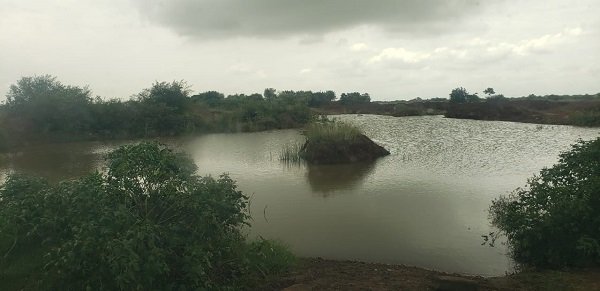
The Minerals Commission has intensified efforts to clamp down on illegal sand winning activities across the country following the discovery of several unlicensed sites in the Ningo-Prampram Municipality.
The illegal operations have left vast stretches of land riddled with deep craters, many of which have become waterlogged, posing serious environmental and public safety risks to surrounding communities.
As part of efforts to enforce compliance with mining regulations, the Commission has launched an enforcement operation targeting illegal sand winning activities.
The operation, which was also aimed at enforcing compliance in terms of mining other industrial minerals took the team to Skyline Quarries and CT Quarries, where managers were directed to present all operational and licensing documents to the Commission by Friday for verification.
The exercise also uncovered the use of suspected fake Minerals Commission waybills by illegal sand winners to evade regulatory controls and deprive the state of substantial revenue.
Briefing the journalists after the operation yesterday, the Deputy Chief Executive Officer of the Minerals Commission in charge of Small-Scale Mining and Industrial Minerals, Mr Maxwell Klu, warned that individuals and organisations engaged in unlicensed sand winning would face the full rigours of the law.
He explained that a preliminary examination of some of the waybills retrieved from operators suggested that they were counterfeit and would be subjected to further verification.
According to him, investigations would be extended to identify and prosecute those involved in the printing and distribution of the fake waybills.
Mr Klu said the existence of the counterfeit documents suggested that some individuals were operating an illegal network that diverted revenue meant for the state into private hands.
He explained that under the law, sand winning operators are required to obtain permits from the Minerals Commission and fulfil statutory obligations, including the payment of annual mineral rights fees, ground rent and royalties.
However, he said, illegal operators circumvent these requirements, depriving the state of revenue while operating outside the Commission’s regulatory oversight.
Mr Klu explained that the situation made it difficult to enforce environmentally sustainable mining practices, allowing operators to excavate land indiscriminately and leave behind deep craters and other environmental hazards.
He noted that waybills used for the transportation of sand and other industrial minerals constitute an important source of government revenue, but the use of counterfeit documents had significantly undermined the system.
Although the Commission could not immediately quantify the financial losses occasioned by these illegal activities, Mr Klu said the amount of revenue being lost through illegal sand winning and the use of counterfeit waybills was substantial.
He said a comprehensive investigation into the scheme would reveal the true extent of the revenue leakages.
Mr Klu stressed that persons found to have produced, distributed or used fake waybills, as well as those engaged in illegal sand winning, would be prosecuted under the Minerals and Mining Act and other applicable laws.
He reaffirmed the Commission’s commitment to intensifying enforcement operations across the country to curb illegal sand winning, protect the environment and ensure that all operators comply with the nation’s mining regulations.
FROM CLIFF EKUFUL, PRAMPRAM
Follow our WhatsApp Channel now! https://whatsapp.com/channel/0029VbAjG7g3gvWajUAEX12Q

