


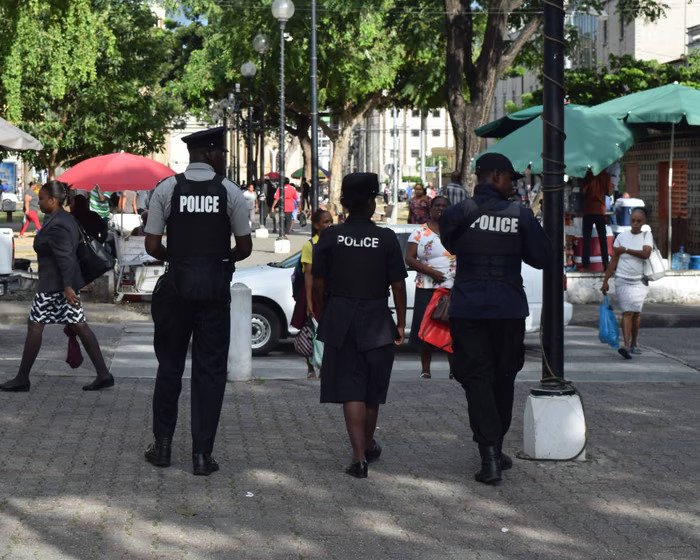
Journalists in Trinidad and Tobago have called for an urgent amendment to a sweeping new bill that increases police powers of search and seizure, which they argue threatens the country’s much-vaunted freedom of the press.
The government says the special operations bill 2026, passed on 24 September, is designed to tackle alarmingly high crime and murder rates in the Caribbean nation.
The country has spent more than a year in an almost perpetual state of emergency, with police empowered to bypass normal constitutional rights around arrest, detention, and search and seizure.
But journalists in Trinidad and Tobago have called for explicit exemptions in the new legislation to prevent police from searching and seizing their notebooks, phones and laptops.
In the past, journalists have been forced to challenge warrants empowering police to raid their homes and offices.
Although the country prides itself in honouring freedom of speech, ranking 19 out of 180 countries in the 2025 Reporters Without Borders press freedom index, this year it fell 13 places to 32, and journalists say they are deeply concerned about whether they can protect whistleblowers and vulnerable sources who share information on the understanding that they will be protected.
The president of the Media Association of Trinidad and Tobago (MATT), Prior Beharry, said the organisation had called for clause 15 of the bill to be urgently amended “to explicitly shield our devices and materials … and confidential source information from standard police seizure”.
Clause 15 prevents police from seizing “a tool of a lawful trade or business” or material protected by legal professional privilege.
But MATT says journalism is not explicitly recognised as a protected trade, nor does the bill establish a procedure for handling confidential journalistic material discovered during searches.
It wants the clause changed to “expressly name journalism as a protected lawful trade and safeguard journalists’ devices, materials and confidential sources”.
Beharry said the bill’s search‑and‑seizure powers were particularly worrying in a digital era where “the tools of a journalist is … usually a cell phone”.
Though he said journalists had not been directly threatened under recent states of emergency, he warned that other restrictions were worsening.
“One of the issues we are having is the access to the government, the executive, including the prime minister, who has not had an official press conference for more than a year,” he said. “Ministries use state resources and we are not invited, but state media is invited.”
The independent journalist Pearce Robinson said the combination of surveillance capability, expanded search powers, without explicit protection for journalistic practice, and declining access to government ministers created a “concrete” threat to press freedom, with a particularly significant impact on investigative reporting. -The Guardian
Read the *Ghanaian Times* and *The Spectator* newspapers digitally on [TimesNewsPlus](https://timesnewsplus.com/newspapers).
Follow our WhatsApp Channel now! https://whatsapp.com/channel/0029VbAjG7g3gvWajUAEX12Q

