


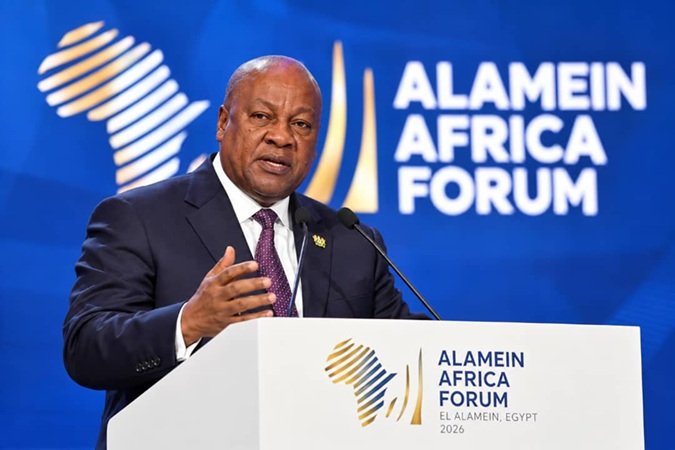
Ghana’s President, John Dramani Mahama has called on African governments, financial institutions and private investors to reposition healthcare as a high-growth economic sector capable of driving industrialisation, job creation and economic resilience across the continent.
Delivering a keynote address at the inaugural Alamein Africa Forum in El Alamein, Egypt, President Mahama said Africa must move away from viewing healthcare primarily as a social expenditure and instead mobilise capital to develop pharmaceutical manufacturing, regional supply chains and health-related industries.
Speaking at the plenary session on “Investing in Health: Manufacturing and Regional Value Chains,” the President said the continent’s quest for health sovereignty presents a significant investment opportunity for African businesses and financial institutions. He indicated that health is not a charitable cause; rather, an investable and high-growth economic sector.
The President further noted that investment in healthcare generates wider economic benefits through improved human capital, manufacturing, employment and macroeconomic stability whilst commenting on the continent’s health sector import dependency.
President Mahama expressed concern about Africa’s continued dependence on imported health products, noting that the continent imports more than seventy (70) percent of its pharmaceuticals and nearly ninety – nine (99) percent of its vaccines. This dependence, he said, results in tens of billions of dollars leaving African economies annually while exposing countries to disruptions in international supply chains. The challenge has become more pressing as traditional donor support declines.
For investors, however, the President said the import dependence represents a major opportunity for import substitution and domestic manufacturing as Africa’s population is projected to reach about 2.5 billion by 2050, creating growing demand for essential medicines, chronic disease treatments, vaccines and biologics.
Coupled with the market opportunities presented by the African Continental Free Trade Area (AfCFTA), local pharmaceutical manufacturers could increasingly produce for a continental rather than purely domestic market.
President Mahama pointed to pooled procurement as another mechanism capable of creating predictable demand for African manufacturers.
He cited the Africa CDC’s pooled procurement initiative for maternal and child health products, which he said generated substantial price reductions while enabling African manufacturers to secure half of the product lines.
“Ghana is already taking steps to move from being predominantly a consumer of health products to becoming a producer. The country’s strategy includes strengthening domestic pharmaceutical manufacturing, expanding healthcare financing and reducing dependence on donor-supported vaccine procurement. Initiatives including the expansion of the National Health Insurance Scheme, the Free Primary Health Care Programme and the Ghana Medical Trust Fund, popularly known as MahamaCares, are part of efforts to build a more sustainable health system”, he emphasized.
The President maintained that achieving health sovereignty requires countries to develop the capacity to finance essential health services, regulate products effectively, manufacture essential medicines and establish resilient supply chains.
By Chris KONEY