


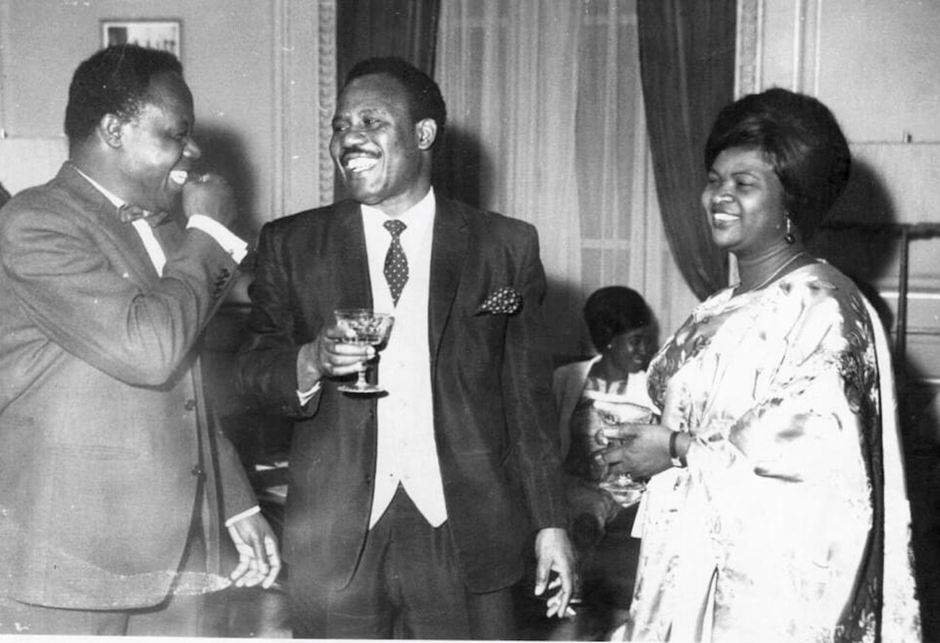
Prince Daniel Kojo Tɛŋgɛ Djokoto was born on May 26, 1924 in Anyako, Aŋlɔ State, into one of the most distinguished royal families in southern Ghana. He was the second son of King Apewu Tɛŋgɛ Dzokoto III, Dufia of Anyako and Commander-in-Chief of the Left Wing Division of the Aŋlɔ State, and Mama Martha Agluma Gbormittah, a prosperous merchant from Simpa whose cosmopolitan outlook contrasted with her husband’s staunch defence of Aŋlɔ traditions.
Growing up, Daniel inherited both worlds. His father embodied traditional authority, political discipline and resistance to colonial influence, while his mother embraced modern education and Western refinement. Their differing philosophies ultimately converged in one decision that shaped his future: to provide him with an excellent education.
He attended the African Methodist Episcopal Zion School at Simpa, where he excelled academically before winning a scholarship to the Prince of Wales College in 1939. There he developed enduring interests in literature, public speaking and music, while also distinguishing himself as an accomplished sportsman. During these formative years he witnessed the political turbulence of the Gold Coast and the increasing demands for constitutional reform and self-government.
Following the death of his father in 1946, Daniel completed his teacher training at the Prince of Wales College and briefly joined its staff. Yet the political awakening sweeping the colony increasingly drew his attention. The watershed events of the 1948 Accra riots transformed Gold Coast politics, bringing him into contact with Komla Agbeli Gbedemah, fellow Anyako native and one of the principal architects of Ghana’s nationalist movement.
Encouraged by Gbedemah, Daniel joined the Committee on Youth Organisation of the United Gold Coast Convention (UGCC). He witnessed first-hand the ideological tensions between the conservative leadership of the UGCC and its dynamic General Secretary, Kwame Nkrumah. When Nkrumah eventually broke away to establish the Convention People’s Party (CPP), Daniel joined the new movement alongside many young nationalists who believed constitutional reform should lead directly to self-government.
Although born into royalty, Daniel recognised that the future of the country depended upon national rather than sectional politics. He admired Nkrumah’s vision of African unity while maintaining an essentially constitutional outlook, believing political progress should be grounded in sound institutions and enlightened leadership.
In 1950 he founded D. K. T. Djokoto & Co., a multidisciplinary family office established to manage the affairs of the Tɛŋgɛ Dzokoto Royal Family and support indigenous enterprise during an era when expatriate firms dominated commerce. The firm financed merchants, brokered commodity trade, provided bookkeeping and commercial services, and reorganised the family’s assets into a modern business structure. Daniel understood that enduring influence required economic strength as much as political prestige.
His intellectual ambitions continued to grow. In 1952 he became one of the pioneering students to move from Achimota to the newly established University College of the Gold Coast at Legon as a founding member of Legon Hall. Recognising the increasing importance of constitutional law in a rapidly changing society, the royal family encouraged him to pursue legal studies abroad.
Daniel travelled to Britain in 1955, enrolling at the Inns of Court School of Law, University of London, where he earned his Bachelor of Laws degree in 1958. During this period he married Agatha Quansah, a trained teacher whom he had met several years earlier. Their marriage became one of remarkable stability and affection, producing five children while providing a welcoming home for friends, diplomats and distinguished visitors alike.
In 1960 Daniel was called to the Bar by the Honourable Society of the Inner Temple. That same year President Kwame Nkrumah appointed him Second Secretary at Ghana’s High Commission in London, where he began a distinguished diplomatic career. As Ghana entered the era of the First Republic, Daniel helped represent the newly independent nation during one of the most transformative periods in African history.
His diplomatic responsibilities steadily expanded. Promoted to First Secretary and later Minister-Counsellor, he represented Ghana at several important international gatherings, including the United Nations Conference on Consular Relations in Vienna in 1963. There he argued for progressive interpretations of international consular law and demonstrated the measured diplomacy for which he became respected.
His service extended beyond diplomacy into education, maritime affairs and international legal cooperation. He represented Ghana at the Third Commonwealth Education Conference, participated in the Intergovernmental Maritime Consultative Organisation, and served on the Asian-African Legal Consultative Committee, contributing to discussions on refugee protection, international law, taxation and peaceful coexistence among newly independent nations.
Throughout these years Agatha played an indispensable role in supporting his public life. An accomplished hostess and educator, she cultivated an atmosphere of warmth around the Ghanaian diplomatic missions where they served, accompanying her husband on official engagements while maintaining a close-knit family despite the demands of diplomatic service.
The military coup of February 1966 reshaped Ghana’s political landscape, but Daniel continued serving the Republic with characteristic professionalism. He was transferred as Chargé d’Affaires to Ghana’s Embassy in Cairo, where he and his family experienced the upheaval of the 1967 Arab-Israeli Six-Day War. During this period Agatha established the Diplomatic Wives Association to support newly arrived Ghanaian diplomatic families adapting to life abroad.
Despite changes in government, Daniel remained committed to public service rather than partisan politics. He served on the Commission of Inquiry into the affairs of the State Fishing Corporation, whose extensive investigations reflected his reputation for diligence and integrity.
When invited by the Busia administration to serve as Ambassador to Italy, Daniel declined. His ambition had shifted towards the judiciary, believing that Ghana’s long-term stability depended upon an impartial legal system and the rule of law. Returning permanently to Ghana, he was called to the Ghana Bar in 1971 and shortly afterwards appointed to the Judicial Service.
His judicial career, however, proved tragically brief. Prince Daniel Kojo Tɛŋgɛ Djokoto died in 1972 at the age of forty-eight while residing at the official government residence near Christiansborg Castle. His passing deprived Ghana of a jurist whose diplomatic experience, legal scholarship and statesmanship promised even greater national service.
Prince D. K. T. Djokoto belonged to a generation that guided Ghana from colonial rule into independence. He was simultaneously royal prince, educator, entrepreneur, lawyer, diplomat and judge — a rare combination that enabled him to bridge tradition and modernity with remarkable ease.
His life reflected an unwavering commitment to constitutional government, African unity and public service. While deeply proud of his Aŋlɔ heritage, he believed patriotism required service beyond one’s clan or kingdom. His work in diplomacy strengthened Ghana’s international standing, while his legal career demonstrated an abiding faith in justice as the foundation of national development.
More than half a century after his death, Prince Daniel Kojo Tɛŋgɛ Djokoto remains a compelling example of principled leadership. His career illustrates how scholarship, public duty and cultural heritage can combine in the service of nation-building. His legacy continues not only within the Tɛŋgɛ Dzokoto Royal Family but also within the broader history of Ghanaian diplomacy and constitutional development, reminding future generations that true nobility is measured not by birth alone, but by devoted service to one’s country and to humanity.
Authored by V. L. K. Djokoto, Partner, D. K. T. Djokoto & Co.
Follow our WhatsApp Channel now! https://whatsapp.com/channel/0029VbAjG7g3gvWajUAEX12Q

