


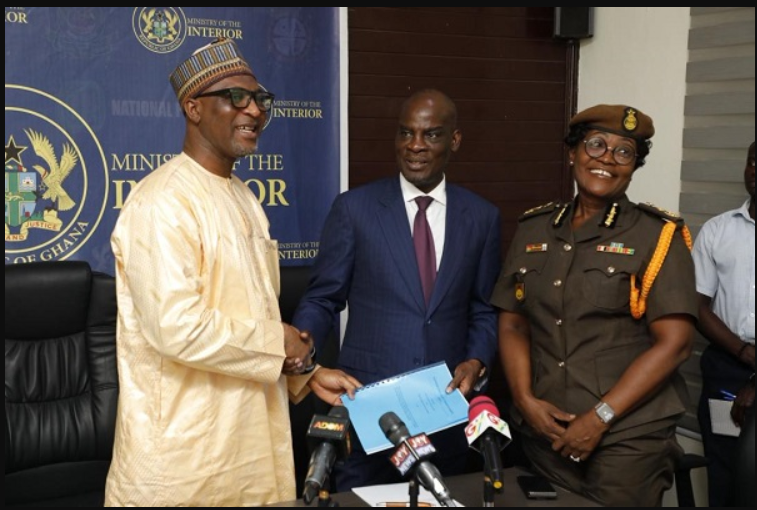
THE Ministry for the Interior and the Ministry of Education have signed three Memoranda of Understanding (MoUs) mandating the Ghana Prisons Service to locally produce school furniture, uniforms and sanitary pads for basic and secondary schools across the country.
Under the agreements, inmates of the Ghana Prisons Service will be trained in vocational skills such as carpentry, tailoring and machine operation to support the production of the items.
Speaking at the signing ceremony in Accra yesterday, the Minister for the Interior, Mr Muntaka Mohammed-Mubarak, said the MoUs reflected a deliberate policy decision to integrate education delivery, local manufacturing, value-for-money procurement and inmate rehabilitation into a single national intervention.
He said the government had identified persistent shortages of school furniture, uniforms and essential learner support items, particularly in underserved communities, which continued to affect learning outcomes and student welfare.
Mr Mohammed-Mubarak noted that the initiative would also strengthen local production capacity, reduce reliance on imports and ensure that public spending generated measurable social and economic benefits.
According to him, the concessions would be implemented through the industrial and vocational infrastructure of the Ghana Prisons Service to ensure timely supply, quality assurance and equitable distribution, in collaboration with agencies in the education sector.
The Director-General of the Ghana Prisons Service, Mrs Patience Baffoe-Bonnie, described the MoUs as a “game-changer,” saying they would reposition prisons as centres of productive labour rather than solely places of incarceration.
She said the programme would help reduce recidivism by equipping inmates with employable skills and offering income-earning opportunities while in custody, adding that revenue generated would support prison expansion, retooling and improved facilities.
Also speaking, the Minister of Education, Mr Haruna Iddrisu, indicated that the collaboration aligned with government policy to promote indigenous industries and ensure that public procurement supported local production.
He disclosed that more than 12 million sanitary pads were expected to be distributed nationwide in 2025, with projections rising between 15 and 20 million in subsequent years.
Mr Iddrisu added that future procurement under the education sector would be guided by the MoUs to prioritise local production through the prisons system.
He also highlighted that the government was exploring the use of alternative materials, including plastics and recycled waste, for the manufacture of school furniture as part of its environmental sustainability agenda.
The ministers reaffirmed their commitment to transparency, accountability and timely delivery under the agreements, describing the initiative as a model of cross-ministerial collaboration aimed at improving education outcomes while supporting inmate rehabilitation and local industry.
BY RAYMOND APPIAH AMPONSAH
Follow Ghanaian Times WhatsApp Channel today. https://whatsapp.com/channel/0029VbAjG7g3gvWajUAEX12Q
🌍 Trusted News. Real Stories. Anytime, Anywhere.
✅ Join our WhatsApp Channel now! https://whatsapp.com/channel/0029VbAjG7g3gvWajUAEX12Q

