


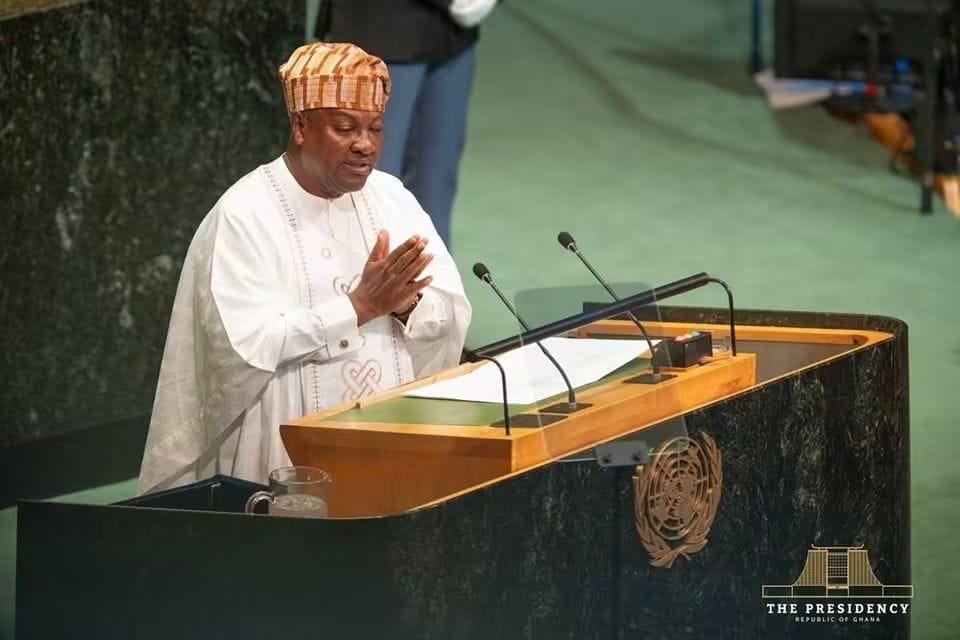
President John Dramani Mahama says the UN resolution affirming the transatlantic slave trade as the gravest crime against humanity must lead to structural transformation of the global system.
“We thank every nation that voted for justice, and I am deeply grateful to our brothers and sisters in the African Union, CARICOM, CELAC, and our partners across the Global South,” President Mahama said at the 81st UN General Assembly in New York today.
“That resolution was not a mere gesture. It was adopted because the structural legacies of those historic crimes continue to fuel systemic racism, economic marginalisation, and a global financial architecture weighted against Africa and people of African descent,” he stated.
He welcomed positive overtures since the passage of the resolution, noting that the Netherlands, Germany and France have made moves to join the conversation on reparatory justice and restitution.
“But real repair demands structural transformation. It requires dismantling the persistent engines of exploitation: unfair global trade regimes, predatory resource extraction, discriminatory credit ratings, unsustainable debt burdens, and the continued export of raw materials from Africa while real value addition and job creation occur elsewhere,” he said.
On global governance, President Mahama said the injustices of the past remain embedded in today’s power structures.
“Africa is home to 1.5 billion people, over 18 per cent of humanity, and constitutes the largest regional voting bloc in this General Assembly. Yet, Africa remains without a single permanent seat on the United Nations Security Council. This is fundamentally unacceptable in the 21st century,” he said.
“Africa must be granted permanent representation on the UN Security Council, complete with all the rights, responsibilities, and veto powers of such membership. We cannot credibly champion the sovereign equality of nations while preserving a global governance structure designed for the post-war geopolitical realities.
Security Council reform is not a favour to Africa; it is an imperative for the legitimacy, credibility, and survival of the United Nations.”
President Mahama said the same systemic inequality permeates the international financial architecture, with developing nations borrowing at interest rates up to eight times higher than industrialised nations.
“African and Caribbean nations struck by climate disasters are forced to take on crippling debt to rebuild from floods and droughts they did not cause. Governments are forced into a tragic choice: to service predatory debt or serve their people. We demand reform. We need long-term, affordable, and accessible concessionary financing that enables developing economies to invest in human capital, industrialisation, and climate adaptation,” he said.
“Africa does not seek charity. Africa seeks equal partnership anchored in mutual respect. Our continent possesses the world’s youngest population, vast arable land, unparalleled cultural vitality, and the critical minerals required to drive the global green energy transition.
But Africa will not remain a passive arena for a new scramble for resources. Critical mineral extraction must not replicate colonial-era exploitation. We will process our minerals at home, build local industries, create dignified jobs for our youth, and retain the value of our natural resources.”
By Edem Mensah-Tsotorme